Private IB Physics HL tutoring — online, one-to-one, application-only

IB Physics HL tutor for students aiming at a 6 or 7

A private IB Physics HL tutor for Diploma students working through the current syllabus (first assessment 2025). Renzo Diaz teaches one-to-one online from Milan, worldwide, covering the full AHL content, Papers 1A, 1B and 2, and the scientific investigation. Application-only, with two free conversations before anyone commits.

At HL, the problem is almost never that your child has not read the chapter. It is a broken step in the reasoning — a sign convention in fields, a sloppy assumption about energy transfer in induction, a diagram never drawn. Re-performing the syllabus at a lower speed does not find that step. Finding it is a different job, and it is the actual job.

HL is a long game. The students who finish with a 7 are usually the ones who stopped surviving week to week somewhere in DP1 and rebuilt the course on understanding rather than memorised procedures. That is the work I do: diagnosis first, then a fixed weekly rhythm, every session recorded and archived, for students who intend to take physics, engineering, or mathematics further. If your child is pairing Physics HL with Maths AA HL, the two are often repaired together — the maths HL physics assumes is frequently where a physics plateau actually lives.

The high-achiever gap: ahead at IGCSE or MYP, suddenly behind at HL

The student who coasted through IGCSE Physics or MYP Sciences meets HL pace in the first term of DP1 and quietly switches from confidence to survival mode. Homework gets done, nothing gets understood, and the gap compounds because every HL topic assumes the previous one is solid. The fix is not more hours. It is a precise audit of which foundations — usually vectors, proportional reasoning, or energy bookkeeping — were never actually built, then rebuilding them while keeping pace with the class.

Fields and potentials: where formula memorisation stops working

Theme D is the most abstract region of the course, and it is where memorising equations stops working. Gravitational and electric fields, potential, potential energy, the inverse-square relationships, the link between field strength and potential gradient: students who got this far on pattern-matching find there is no pattern to match. We rebuild this material from the definitions up, on a shared whiteboard, until the student can derive rather than recall — because Paper 2 will ask for derivation, not recall.

Unfamiliar-context questions: electromagnetic induction and quantum, mainly

Electromagnetic induction and the quantum content of Theme E are conceptually counterintuitive, and examiners know it. These are the topics most often dressed in unfamiliar contexts: a novel generator arrangement, a photoelectric setup the student has never seen. Students who "understood the lesson" freeze because their understanding was tied to one diagram. The remedy is practising the transfer — same physics, deliberately strange wrapping — with full written reasoning, until the unfamiliar stops being frightening.

Paper 2 extended response: the 8-mark question that collapses on line two

IB Physics HL Paper 2 is where grades are decided. The extended-response questions run eight marks or more, and one early wrong assumption — a misidentified system, a wrong sign, an unjustified conservation claim — cascades through the whole answer and takes the marks with it. We work these questions line by line, from archived wrong answers, training the habit of checking each step against the physics before building on it. Method marks reward visible reasoning, so we make the reasoning visible.

The 6-versus-7 stakes: aiming at physics or engineering, where it changes your options

For a student applying to physics, engineering, or natural sciences, the HL grade is not decorative. Competitive offers are made and missed on the difference between a 6 and a 7, and the final stretch is the hardest: the marks live in the hardest Paper 2 parts, in data-based Paper 1B questions, and in an IA held to HL standards of analysis. This is the situation where one-to-one diagnosis earns its keep, because generic revision cannot target a two-mark gap.

Coverage — the full HL course, first assessment 2025

The full HL syllabus, including every AHL topic

I teach the current IB Physics syllabus (first exams May 2025), which you can verify against the IB's official subject page. HL students study the complete core plus the additional higher level material across all five themes, and we work through all of it — in the order the student's school teaches it, with extra depth wherever diagnosis finds weakness. Assessment is Paper 1 (1A multiple choice plus 1B data-based questions), Paper 2 (structured and extended response, including AHL content), and the scientific investigation worth 20%. There are no longer any options papers.

  • Theme A: Space, time and motion — kinematics, forces, momentum, energy, plus the HL-only rigid-body and rotational mechanics: torque, moment of inertia, angular momentum
  • Theme B: The particulate nature of matter — thermal physics with full HL thermodynamics depth: ideal gases, the first law, entropy and cycles
  • Theme C: Wave behaviour — waves at HL depth: interference, diffraction, standing waves, and the Doppler effect handled quantitatively
  • Theme D: Fields — gravitational and electric fields and potentials in depth, plus electromagnetic induction, the section where most HL grades quietly die
  • Theme E: Nuclear and quantum physics — radioactive decay, fission and fusion, and quantum concepts at HL depth: photoelectric effect, matter waves, energy levels
  • IB Physics HL Paper 2 technique — extended-response structure, derivation practice, mark-scheme literacy, and timing under exam conditions
  • Paper 1B data-based questions — interpreting unfamiliar experimental data, uncertainty analysis, and critique of method
  • IB Physics HL IA help — choosing a feasible research question, designing the experiment, and reaching genuine analysis depth, within the IB's academic honesty rules

The method

Diagnosis first. Then a fixed weekly rhythm.

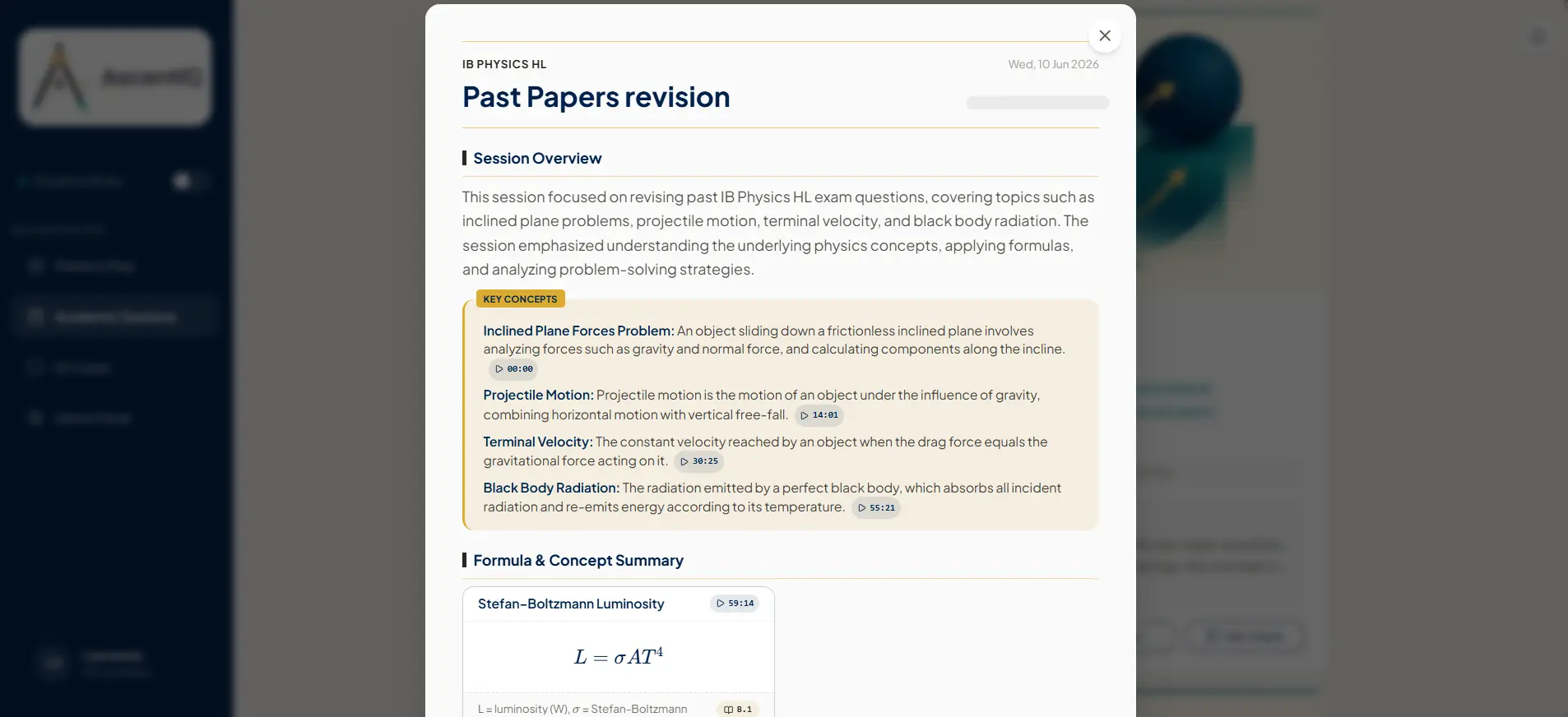
Every engagement starts by finding the exact step where the reasoning broke — not the topic, the step. From there we settle into a fixed weekly session that opens with last week's wrong answers, because an error revisited is worth more than a new chapter skimmed. Sessions run on Zoom with a shared Excalidraw whiteboard, and every session is recorded, summarised, and archived into a searchable library the student keeps — so nothing we fix is ever lost. I am based in Milan and teach online, one-to-one, with students worldwide.

Documented, not promised

HL is a long game. The proof matches.

HL results come from multi-year engagements, so those are the cases worth showing. Greta Lotti began working with me at IGCSE Maths 0607 in Italy and continued through IB Physics HL: "One of the things I appreciated the most about his teaching is that he never simply explained the exercise I was struggling with. Instead, he would always try to identify the root of my confusion, taking time to fill in the knowledge gaps… he was always looking for new ways to explain complex concepts." Yuval Rossen worked with me through both IB Math HL and Physics HL in Ireland: "My knowledge and understanding has dramatically boosted… I was very well prepared for both exams." He went on to study applied physics at university — and chose to continue lessons through his degree. Both statements are public on the results page.

Physics HL rewards understanding. That is what I teach.

If your child is serious about Physics HL — whether the target is survival, a 6, or the 7 that keeps a physics or engineering offer open — the next step is a conversation, not a commitment. Apply, and we will find out together whether this is the right fit. An IB Physics HL tutor who starts with diagnosis will tell you more in one session than a term of re-explained textbook ever will.