Renzo Diaz is an IB Physics tutor based in Italy, with an M.Sc. in Energy Engineering from the Politecnico di Milano, teaching IB since April 2016 and one-to-one online since 2020. He teaches IB Physics at Standard and Higher Level, in English or Spanish. Documented online result: IB Physics SL from a 3 on the first Diploma report card to a final 7 (May 2025), the first session of the current syllabus.
Every lesson is taught by Renzo Diaz himself, one-to-one on Zoom, and recorded with an AI-generated summary in a searchable archive. His IB teaching record is dated by third parties from April 2016, and his public Google record holds 19 reviews since June 2020, at least one in every calendar year. The aim is for your child to read a physical situation, choose an appropriate model and explain the reasoning that leads to the answer. We work on the step that needs attention — a physical concept, the mathematics behind it or the way the solution is communicated — so they can approach the next question with greater independence.
Renzo DiazPrivate IB Physics tutor — Milan and online
Documented IB Physics SL result: from a Grade 3 to a final 7 (May 2025)
Result 01Documented case
3 → 7
IB Physics SL — final grade
Blake Eustaquio · Metropolitan School of Panama (Panama). Online from September 2023 to the May 2025 IB examinations, the first session of the current Physics syllabus.
IB Physics with an engineer: M.Sc. Politecnico di Milano and a dated IB teaching record since 2016
My engineering background informs how I teach Physics: identifying the system being studied, making assumptions explicit and connecting the physical model to the mathematics. The student learns to explain why a relationship applies, rather than choosing it only because its symbols look familiar.
My IB teaching began in April 2016. The dated record on my About page includes my recruitment by Pi Greco Milano Tutoring for IB Physics HL in March 2018, and my M.Sc. from the Politecnico di Milano in July 2020.
Why IB Physics grades stall: four situations I work on
Formula selection: they can recite it, they can't choose it.
The most common wall in IB Physics isn't knowledge — it's selection. Faced with an unfamiliar situation, students reach for the last formula they saw instead of reading what the problem actually describes. And under exam time, the wrong first choice costs twice: the marks for this question, and the minutes owed to the next one. That instinct is rebuilt, not lectured away.
Data-based questions: the concepts make sense, the questions still don't.
Data-based and unfamiliar-context questions are where the IB separates understanding from recognition. Students who "get it" in the abstract freeze when the numbers are real. We train exactly that transfer, every single week.
Maths inside physics: it's the real problem, not the physics itself.
A surprising share of Physics stuckness is actually algebra, trigonometry, or graph interpretation wearing a Physics costume. With an engineer's eye for both subjects, I treat the cause — not the costume.
HL pace: it turned confidence into survival mode.
Higher Level doesn't just add topics — it adds pace and depth at the same time. Students who were comfortable at IGCSE or MYP suddenly feel permanently behind. The plan needs to match the gaps, the workload and the time available for independent practice.
Coverage
IB Physics tutoring for both levels: SL and HL
SL and HL share the same five themes and the same papers, but HL adds a layer of depth that changes how the whole course has to be prepared. Each level has its own page, with the situations, syllabus coverage and exam technique specific to it.
IB Physics SL
Standard Level — the full core, Papers 1A/1B and 2.
IB Physics exam structure: two papers and one investigation, at SL and HL
The current IB Physics course was first examined in May 2025. SL and HL sit the same components — HL for longer, with more questions and the HL-only content — and there is no longer a Paper 3 or an options paper. A calculator and a clean copy of the physics data booklet are required in every written paper.
IB Physics exam papers and the scientific investigation, SL and HL: duration, marks, weight and what each tests
Paper
Duration
Marks
Weight
What it tests
Paper 1 — SL
1 hour 30 minutes for 1A and 1B together
45 marks (25 multiple-choice + 20 data-based)
36%
Paper 1A is multiple choice across the syllabus; Paper 1B is built on experimental data.
Paper 1 — HL
2 hours for 1A and 1B together
60 marks (40 multiple-choice + 20 data-based)
36%
The same structure, including the HL content.
Paper 2 — SL
1 hour 30 minutes
50 marks
44%
Short-answer and extended-response questions.
Paper 2 — HL
2 hours 30 minutes
90 marks
44%
The same format, across the full HL syllabus.
Scientific investigation — SL and HL
10 hours of class time
24 marks
20%
An open-ended investigation of the student's own research question, reported in at most 3,000 words and marked on four criteria: research design, data analysis, conclusion and evaluation.
What I look for
What separates a 6–7 from a 4–5 in IB Physics
These are the patterns I see in students’ work, not IB grade descriptors. Each one can be trained, which is why the work starts by finding out which of them is missing.
What often sits behind a 4–5 and behind a 6–7 in IB Physics, by aspect of the student’s work
In the student’s work
Often behind a 4–5
Often behind a 6–7
Choosing the physics
Reaches for the formula that looks familiar.
Reads the situation, names the physics involved, and only then chooses the equation.
Unfamiliar data
Understands the concepts, but stalls on a graph or data set they have not seen.
Starts an unfamiliar graph or data set with a reasoned approach.
The maths inside the physics
Loses marks to algebra, units and graph reading, not to the physics.
Handles algebra, units and graphs reliably, so the physical decisions are what gets tested.
Uncertainty
Treats uncertainty as a detail at the end, and quietly loses marks across the paper.
Handles uncertainty deliberately, inside the working rather than at the end.
Extended answers
Starts a multi-mark answer well, then the reasoning breaks by the second or third line.
Keeps the chain of reasoning intact from the situation to the conclusion.
Method choice under time
A wrong first choice of method costs time and marks.
Chooses a method quickly and can explain why it works.
Online lessons
How online IB Physics lessons work: diagrams, graphs and reasoning made visible
On Zoom and a shared Excalidraw whiteboard, we can build a diagram, annotate a graph and work through the mathematics together. Your child explains the choices they make, while I can see where the reasoning needs attention. A diagram becomes part of the solution: which forces act, which direction is positive and which relationships apply.
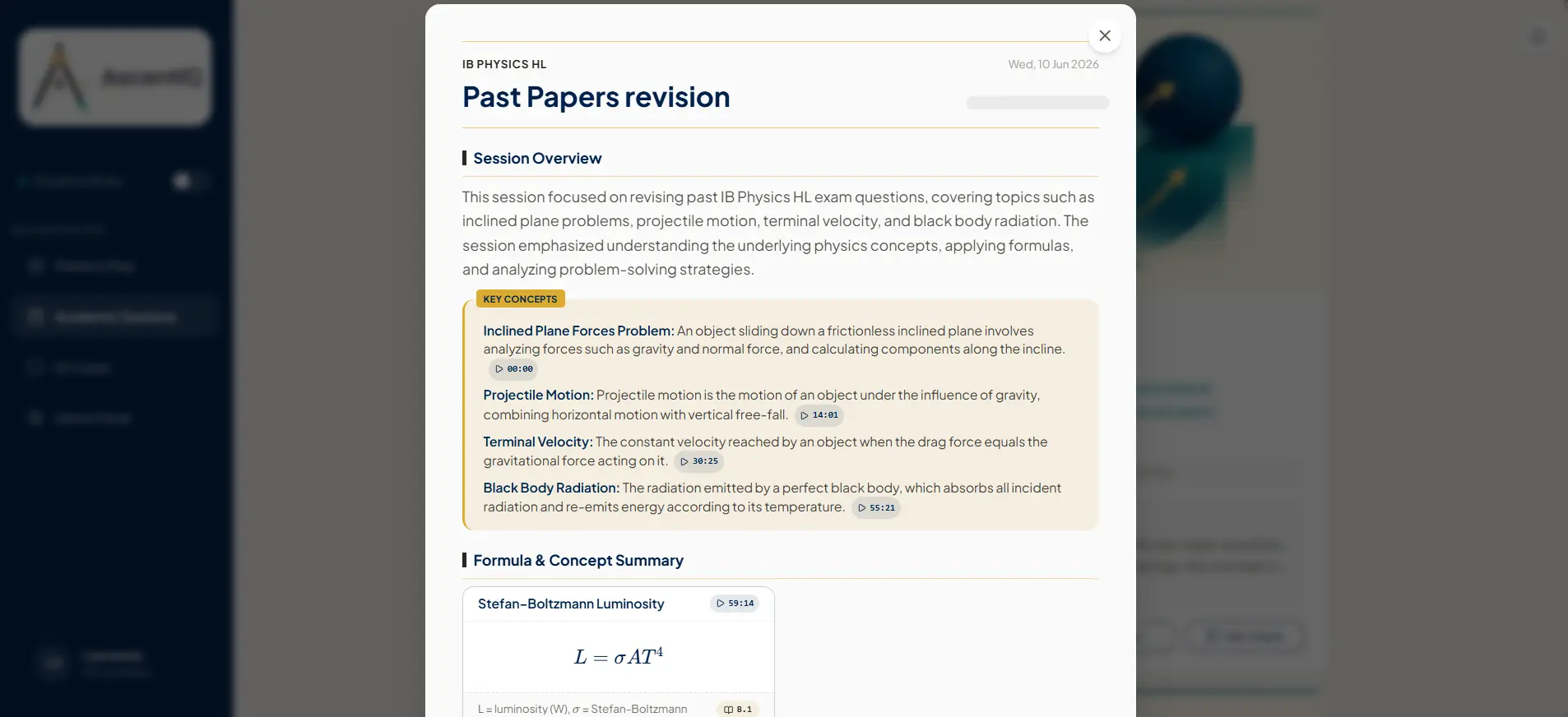
Every session is recorded, with an AI-generated summary linked to the recording, so your child can return to an explanation before practising again. The purpose is to revisit a specific difficulty and use that understanding in a fresh attempt.
From a physical situation to an explainable solution
We work on identifying the system, selecting an appropriate model and checking whether the result makes physical sense. The same habits support diagrams, extended answers and the interpretation of unfamiliar data.
Return to the part you need to practise
The archive connects each session summary to the recording, so a student can go back to the relevant explanation between lessons.
Session archive
Example from an IB Physics HL session archive: an AI-generated summary with timestamped links into the recording.
Online teaching publicly described in July 2020
A Google review from an IB student, dated , describes my use of a touch tablet and screen-shared online lessons. The same account is mirrored on Trustindex: a dated public reference for the online setup already in place at that time.
IB Physics tutoring in public Google reviews: a second final 7 in Physics SL, and two more dated accounts
The public reviews describe different sides of the work — conceptual understanding, exam preparation and support sustained over years. Each card says what its review states, and what it does not. Each review is dated by Google and verifiable on Google, on the Business Profile.
IB Student · Physics HL ·
Conceptual support in IB Physics HL
Several years of support, first in IGCSE Mathematics and then in IB Physics HL, aimed at the root of the confusion and the knowledge gaps behind it. The review describes the teaching without stating a final IB grade. Read the review on Google.
IB Student · Mathematics & Physics ·
A second final Grade 7 in IB Physics SL
Final Grade 7 in IB Physics SL, as the review states
Prepared for Physics SL alongside Maths HL, with one or two lessons a week; the review describes work on understanding, self-confidence and exam-style practice.
IB Student · Physics & Mathematics ·
From the IB Diploma to applied physics at university
Two years of Physics and Mathematics support through the Diploma, with the diploma and results received and lessons set to continue during an applied physics degree. The review does not state the course levels or the final grades.
When a Physics question breaks down at an algebraic rearrangement, a graph or a proportional relationship, we can address that mathematical step within the Physics work. If your child also needs support in their IB Mathematics course, we can discuss a programme that covers both subjects.
Blake’s online work covered IB Physics SL and Mathematics: Applications and Interpretation HL. His final May 2025 grades were 7 in Physics SL and 6 in Math AI HL; the full case explains the difference between predicted and final results.
IB programmes start at €400 a month. That price is for booking directly with me; tutoring platforms that list me add their own commission. Programmes are structured around the student's course and level, so the exact fee is set out before you commit to anything — after I understand the situation, not before. Requesting the strategy call is free and carries no commitment. The first month is four one-hour sessions, and there is no minimum term after it.
Q.02
Do you tutor both IB Physics SL and HL?
Yes. I teach IB Physics at both levels and build the work around the student’s course, current difficulties and exam timeline. HL includes the full SL core plus additional content and longer papers, so the plan differs between the two. The IB Physics SL and IB Physics HL pages set out the support and coverage for each level.
Q.03
My child also struggles with the maths in Physics — can you cover both?
Yes. We can address the mathematical steps a Physics problem needs, such as rearranging an equation or interpreting a graph, inside the Physics work. I also teach all four IB Mathematics courses — AA and AI, at SL and HL — so we can discuss support in both subjects if needed.
Q.04
Can you help with the IB Physics IA?
Yes. I help students understand the investigation requirements, judge whether a research question is feasible, and reason through experimental design, data analysis and evaluation, in line with the school’s instructions and the IB’s academic integrity rules. The student makes the decisions and writes the investigation; I don’t write any part of it. Starting points by theme are in 15 IB Physics IA ideas.
Q.05
When should we start?
Earlier than feels necessary — ideally the first term of DP1, before the HL pace compounds small gaps. But mid-year starts work too, because the first step is always diagnosis. For May exams, starting by January still leaves room for real change.
Q.06
Is online IB Physics tutoring as effective as in person?
Online works when the student takes an active part and practises between sessions. Blake’s documented case ran online from September 2023 to the May 2025 exams, from a 3 on his first report card to a final 7 in IB Physics SL. Free-body diagrams, field lines, graphs and error bars are drawn live on a shared whiteboard, and the data booklet sits open on screen the way it will in the exam. Lab work and the data collection for the scientific investigation happen at school; what I work on is the design, the analysis and the write-up.
Q.07
How long have you been teaching IB online?
My teaching practice has been online since 2020. A Google review dated 12 July 2020 already describes teaching with a touch tablet and screen-shared online lessons. My IB teaching began in April 2016, and the dated record on my About page includes IB Physics HL work in Milan from March 2018.
Q.08
Can I verify your IB Physics results on Google?
Yes, for the reviews. A student’s Google review of 16 July 2022 states a final 7 in IB Physics SL; Blake’s review (6 August 2025) states his starting grade, a 3 in Physics; and a review of 8 July 2026 describes several years of IB Physics HL support. Each is dated by Google, in a record of 19 public reviews verifiable on Google since June 2020. Blake’s final 7 in IB Physics SL comes from his written confirmation, held on file; the 7s in his review were his predicted grades. The case, with its sources, is on its own page.
Q.09
Can my child take online IB Physics lessons from another country?
Yes, subject to a suitable recurring slot. I’m based in Italy and teach online in English or Spanish. When you request a strategy call, share the student’s country, time zone, school timetable and exam session, so we can confirm the schedule works before starting.
Q.10
What does a student need for online IB Physics lessons?
A stable internet connection, a quiet place to work and a way to share written working. We agree the practical setup before the first session, so the student can take part in the diagrams, the calculations and the discussion.
Q.11
What is HL-only in the current IB Physics syllabus?
Five whole topics are taught only at HL: rigid body mechanics, Galilean and special relativity, thermodynamics, electromagnetic induction, and quantum physics. Several shared topics — simple harmonic motion, wave phenomena, the Doppler effect, gravitational fields, electric and magnetic fields, the structure of the atom and radioactive decay — also carry extra HL content. The IB recommends 240 teaching hours for HL against 150 for SL, and the exam time grows accordingly.
Q.12
Is there still a Paper 3 in IB Physics?
No. Since the first exams of the current syllabus in 2025, both SL and HL sit two written papers — Paper 1, split into multiple-choice 1A and data-based 1B, and Paper 2 — plus the scientific investigation. The old options topics are gone too, so any revision material organised around options or a Paper 3 was written for the previous syllabus. If you are still weighing the two levels, IB Physics HL vs SL sets out what actually changes.
Q.13
How are IB Physics exams marked?
Each paper is marked against a detailed mark scheme built from marking points — one mark for each idea, step or value the answer has to contain. A correct numerical answer can earn full marks on its own, but the risk is the same as in Maths: if the final answer is wrong and no working is shown, there is nothing left to award, while written working can still collect marks for the correct steps — including later steps that use an earlier wrong value correctly. The scientific investigation is marked separately: by the teacher, on four criteria worth 24 marks in total, then moderated by the IB. How the 2025 papers spread their marks across the syllabus is counted in the 2025 exams, theme by theme.
Q.14
How do we start?
Request a strategy call through the site: answer a few questions and, if the time and terms fit, choose a slot. I read every request personally. The call is free — 15 minutes with a parent, then 30 with the student on a topic they choose. If the fit is right, the first month is four one-hour sessions, with no minimum term after it; if it is not, I will tell you honestly.
Q.15
What language are the lessons in?
English or Spanish, whichever suits the student. The IB is examined in English, French or Spanish, not in Italian, so the course itself has no Italian version. I also speak Italian.
Free IB Physics strategy call: find the next step in your child’s preparation
Tell me their level, exam timeline and the questions they find hardest to explain. The first conversation helps us assess what needs attention and whether a regular online programme fits their needs and schedule.
We use cookies to understand how visitors use this site, and only load them once you agree. Declining doesn't limit anything you can do here. Privacy Policy