How I work
How I teach IB Math and Physics: diagnose, re-engineer, verify
Renzo Diaz teaches IB Mathematics and Physics with a diagnostic method informed by root cause analysis in engineering: diagnose the cause of a difficulty, re-engineer the explanation around the student’s reasoning, then verify that the understanding transfers to new problems.
In brief
Renzo Diaz, an engineer trained at the Politecnico di Milano, teaches IB Mathematics and IB Physics one student at a time, live online. Before deciding how to explain an idea, he traces the difficulty to its cause; afterwards, he checks that the student can use the idea on a question they have not seen.
A lesson starts from real work, such as homework, a test or an open question. The student attempts and explains on a shared whiteboard, Renzo intervenes where the reasoning becomes uncertain, and the support is then reduced. Every lesson is recorded and summarised, so earlier explanations stay searchable.
The evidence behind the method is public: two students’ IB results are documented by name, each on its own page with its sources, and every public Google review since June 2020 is quoted by its date on the results page.
Key takeaways
- Three movements: diagnose the cause of a difficulty, re-engineer the explanation around the student’s reasoning, then verify that the understanding transfers to new problems.
- A lesson in four steps: start from real work, let the student attempt and explain, intervene where it matters, then check what has changed.
- Every lesson on record: each programme includes the session recording, an AI-generated summary and a searchable archive.
- AI supports judgement, it does not replace it: the student explains a proposed solution, spots a weak step and solves a changed question without the same help.
- The evidence: 4.9 / 5 on Google from 19 public reviews since June 2020 (as of October 2026), and documented IB results, among them a final 7 in IB Physics SL and 7 in both IB Math AI SL exam papers (every result with its source).
A correct answer is useful.
The answer
Knowing how the student reached it is more useful.
The reasoning
The method
The IB tutoring method in three movements: diagnose, re-engineer, verify
I teach IB Mathematics and Physics one-to-one online. My aim is for a student to understand an idea well enough to recognise when to use it, explain their decision and work with increasing independence.
As an engineer trained at Politecnico di Milano, I approach a persistent difficulty by asking what is producing it. A wrong answer alone rarely tells the whole story. I use the student’s own reasoning to decide what kind of explanation or support will be useful.
My approach is informed by Root Cause Analysis in engineering: distinguish a visible failure from the conditions that produced it.
In tutoring, the same wrong answer can come from different causes. The student may misunderstand the concept, misread the question, choose an unsuitable method or lose control of an older mathematical skill.
The intervention should change with the cause.
The approach has three stages
Movement
Diagnose the cause
Observe → Trace
I ask the student to attempt and explain. An incomplete route is often more informative than a polished answer.
We trace the difficulty to the first unreliable decision or missing connection that explains the problem.
That might be inside the current topic. It might also be algebra, proportional reasoning, units or graph interpretation that the new topic has exposed.
The purpose is to identify what needs attention before deciding how much explanation or practice to add.
Movement
Re-engineer the explanation
Rebuild
The diagnosis tells me what is missing. It does not automatically tell me which explanation will make it understandable.
I adapt the explanation to the student’s current reasoning. That may mean changing representation, revealing a relationship or reconnecting a prerequisite in the context where it matters.
The goal is not a rule that works only on familiar questions. It is an idea the student can explain and use.
We may also compare solution routes. The shortest useful route is the shortest one that remains reliable, understandable and appropriate to the assessment.
Movement
Verify the transfer
Verify → Transfer
We change something: the wording, representation, direction of reasoning or combination of ideas.
Then I reduce the support.
Can the student identify what matters? Choose a method? Explain the choice? Recover from an error?
Where appropriate, we connect this to exam conditions: timing, calculator use, notation and the working needed to communicate a valid solution.
Understanding during an explanation is the beginning. Independent use is the stronger test.
What the method is for
Understanding that holds when the question changes
A student may understand a solution while it is being explained yet struggle with a new question alone. In IB Mathematics and Physics, choosing a suitable approach and explaining why it works matter as much as reaching an answer.
My teaching is adapted to the student in front of me. The work may concern a missing connection, a difficult concept or the decisions that cost marks under exam conditions. The point is to develop understanding the student can use without depending on a familiar example, a tutor’s prompt or an AI-generated solution.
The explanation
How IB Math and Physics explanations adapt to the student’s reasoning
Sometimes a student needs more time. Sometimes they need a different way into the idea.
I do not assume that a standard sequence will work just because it is mathematically correct. I look at what the student has understood and construct the next explanation from there.
This is an important part of my professional know-how: deciding which connection to make visible, which representation to change and how much support to provide.
One ideaas it currently sits
- Change the representation
- Reveal a relationship
- Reconnect a prerequisite
An idea the student can explain and use
Explanations developed around the student.
The diagnosis guides the explanation. I adapt the representation, sequence and connections to what the student currently understands, then test the idea on a changed question.
This explanation design draws on teaching experience and a privately maintained body of professional know-how.
The background
How engineering training shapes an IB Math or Physics lesson
Engineering trained me to examine dependencies and compare alternative routes.
In a live session, I track the student’s approach, consider what may be causing the difficulty and adapt the explanation as their reasoning becomes clearer.
The intervention may be a question, a different representation or a direct explanation. Its purpose is to make the next decision understandable and increasingly independent.
Step 01
Examine dependencies
Step 02
Compare alternative routes
Step 03
One carefully chosen next step
The session
What happens in an online IB tutoring session?
We start from relevant evidence.
This may be current schoolwork, a test, an unresolved question or an issue identified in an earlier session.
The student attempts and explains.
We use a shared whiteboard and conversation to make the reasoning visible. Uncertainty is information, not something to hide.
I intervene where it matters.
Depending on the situation, this may involve a question, another representation, a comparison or a direct explanation.
We check what has changed.
The student attempts a variation or continues with less support. We distinguish what now appears secure from what needs more work.
A consistent standard: explanations built around the student’s reasoning.
The weekly loop, in a student’s words
“In my case, Renzo and I had a set schedule per week, where we would work on problems I needed help with from school and advance in covering IB syllabus content. Then, he would send me practice questions to do on Revision Village and Showbie to go over my incorrect answers in the following session.”Between assessments
What does progress look like?
Grades are important. Between assessments, we can also look for more specific changes:
- Beginning without immediately asking for confirmation.
- Recognising the structure of an unfamiliar question.
- Explaining why a method applies.
- Using fewer prompts.
- Identifying and correcting an error.
- Moving between equations, diagrams and graphs.
- Communicating sufficient reasoning for the marks.
- Applying an idea again after some time has passed.
A successful attempt in one session is not proof of lasting mastery. Later opportunities to revisit the idea help test that distinction.
The arrangement
What working together involves
I personally deliver each accepted programme. We agree on the course, priorities and recurring schedule before starting. Sessions take place online and give the student room to attempt, question and explain their thinking. The exact programme, digital resources and any work outside sessions are made clear before the first month begins, so the family knows what is included.
This is a collaborative process. Students do not need to start with a high grade, but they do need to participate. I will be direct if the available time or the format of my work does not suit their situation.
The record
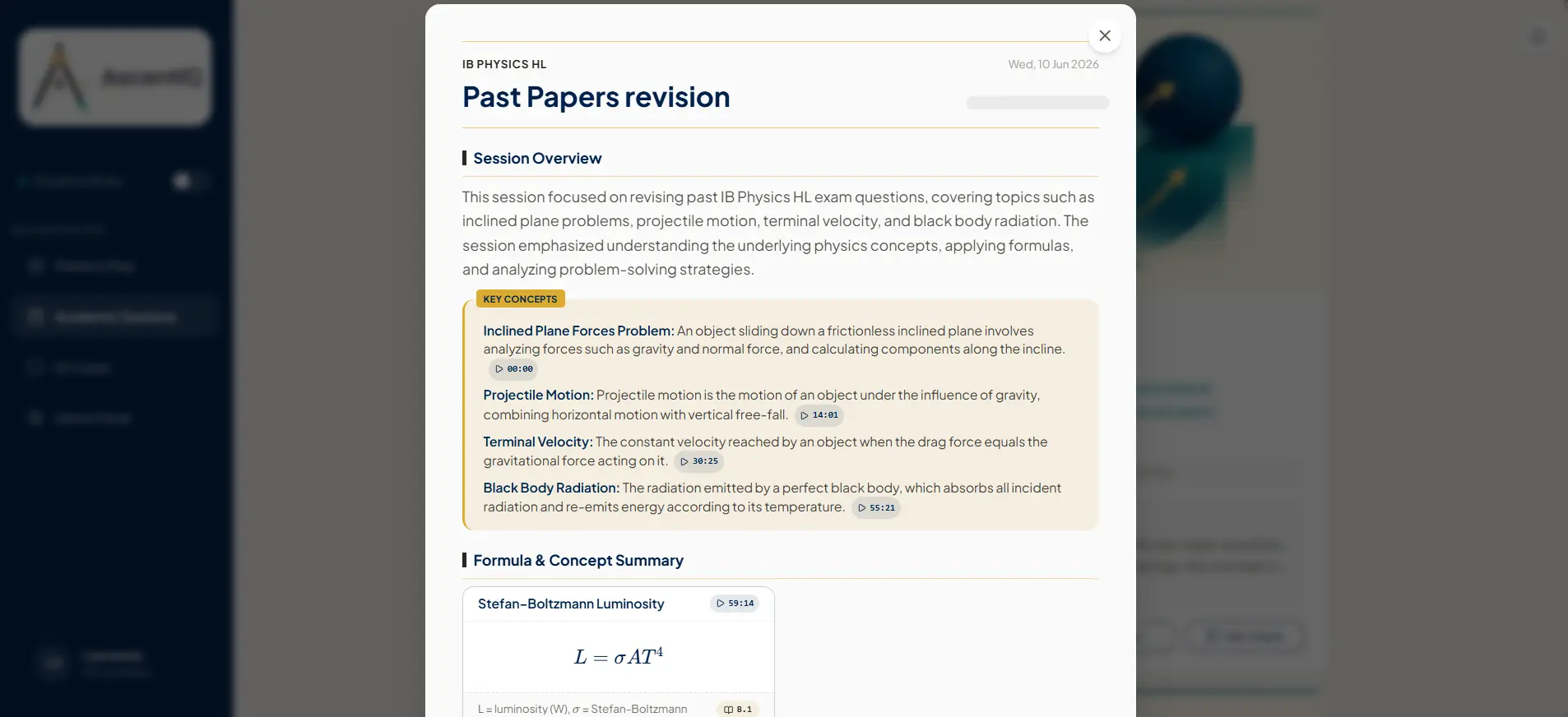
Every IB lesson recorded, summarised and searchable
Recordings and AI-generated session summaries keep previous explanations and problems accessible in a searchable archive.
Students can revisit an idea when it becomes relevant again. Families can see what was covered, and earlier work remains available as the course develops.
Fig. 04
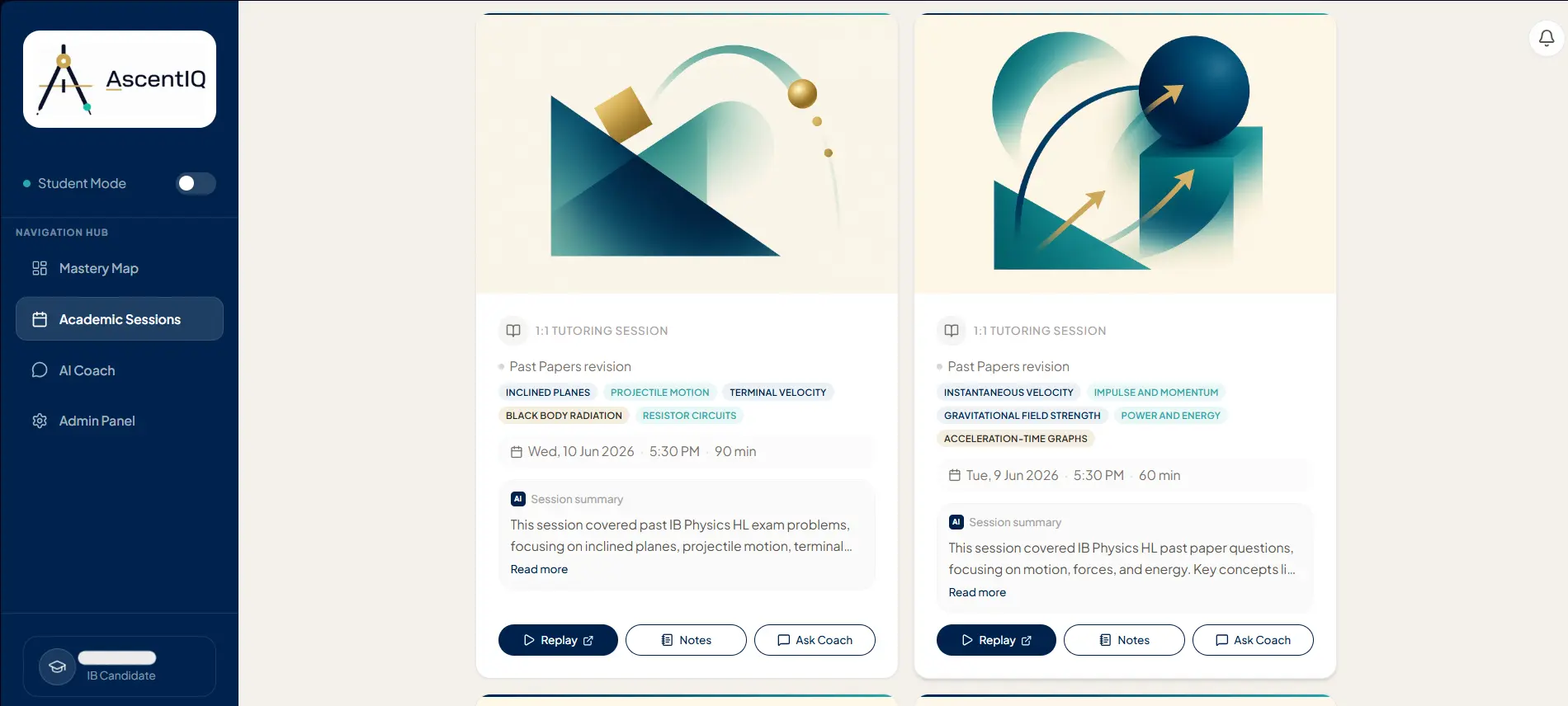
Fig. 05
Practice & AI
How students should use AI in IB Math and Physics practice
The aim is not to eliminate effort or memory. It is to reduce dependence on rote imitation and make practice address a clear need.
A student may need repeated attempts to become fluent. What matters is whether those attempts build understanding and reliable execution rather than repeat the same misunderstanding.
Scope
Assigned practice or correction outside the live session is included only when stated in the proposal.
AI should support judgement, not replace it.
A student can obtain a correct answer from AI without knowing whether the method fits.
When relevant, we examine whether the student can explain a proposed solution, spot a weak step and solve a changed question without the same assistance.
The tool
A correct answer
Obtained from AI — possibly without knowing whether the method fits.
The test
- Explain a proposed solution
- Spot a weak step
- Solve a changed question without the same assistance
The goal is informed use of tools alongside independent reasoning.
Questions
Questions about the IB tutoring method
Is this only for students with weak foundations?
Does the method guarantee faster progress?
Will my child stop needing a tutor?
Is the method a published teaching script?
What is Renzo Diaz’s teaching method?
The evidence
The evidence behind the method: two documented IB cases and 19 public Google reviews
Every public Google review since June 2020 is quoted by its date in the review audit. Two cases there are named and documented, each on its own page with its sources: Aline Pascarelli started IB Math AI SL at Grade 3 and scored 7 in both exam papers (the IB Math AI SL case); Blake Eustaquio went from a 3 to a final 7 in IB Physics SL (the IB Physics SL case). Each is one student’s documented result, not a promised outcome for every student.
The next step
How to start: a free 45-minute strategy call
Fifteen minutes with you, then thirty with the student on a topic they choose; you decide nothing until you have seen how I work. Tell me the course, the current performance and what happens when the student gets stuck.