RENZO DIAZ — Reference library
IB Physics HL vs SL: Content, Papers and How to Choose
3 min readBy Renzo DiazLast reviewed October 7, 2026
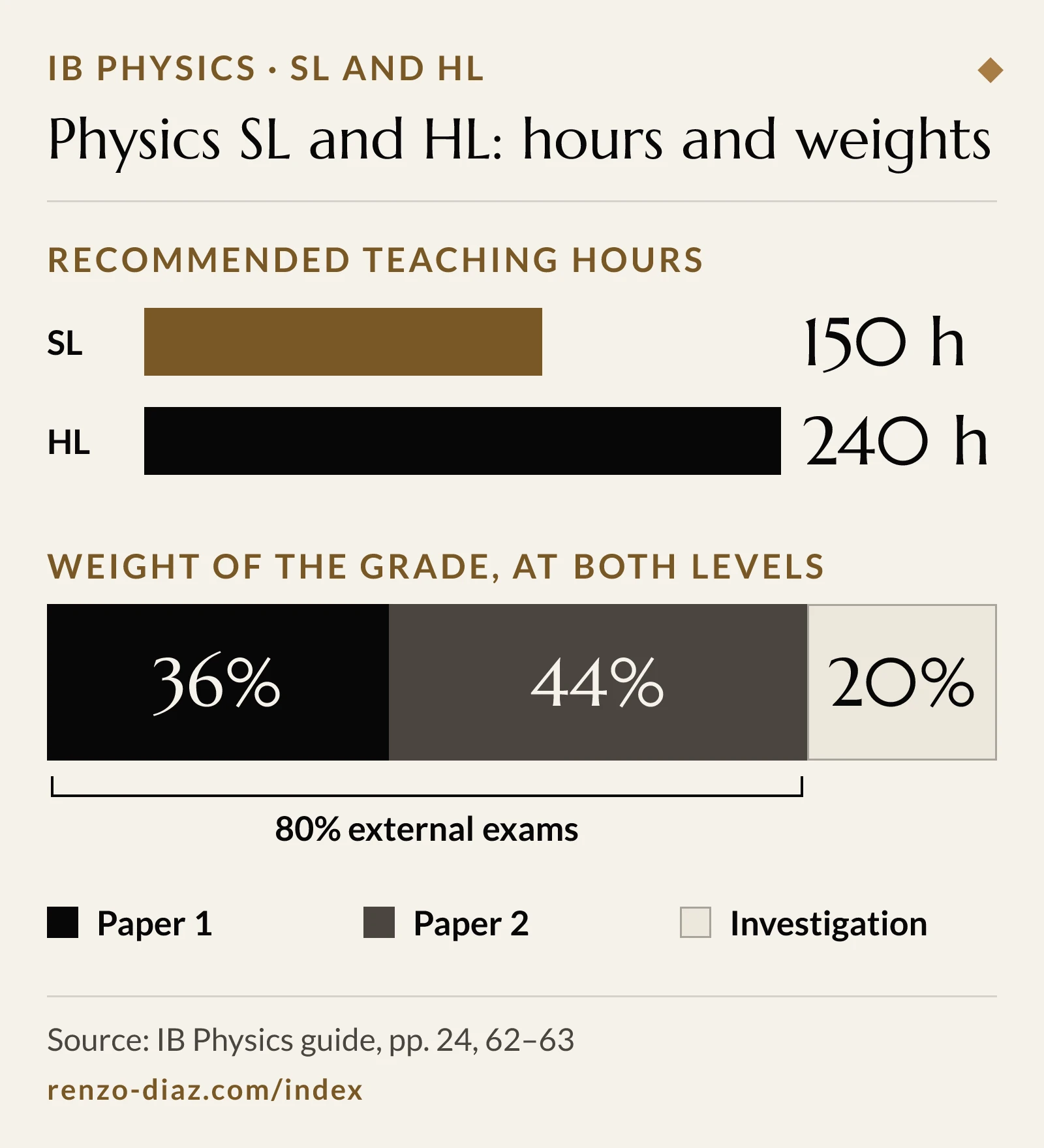
HL Physics means 240 recommended teaching hours against 150 for SL, five whole topics SL does not study, and longer papers: Paper 1 runs 2 hours at HL and 1 hour 30 at SL, Paper 2 runs 2 hours 30 at HL and 1 hour 30 at SL. The weights are the same at both levels (Paper 1 36%, Paper 2 44%, the scientific investigation 20%), and there is no Paper 3 in the current course. The right level depends mainly on what your target degree requires, not on which one sounds harder.
"Should I take Physics HL or SL?" is usually answered by reputation rather than by checking what the two levels require in hours, in exam structure and in what a specific degree will accept. The two levels are not difficulty settings on the same course: SL and HL Physics share most of their content, and HL adds whole topics and longer papers on top.
The right question isn't "which level is harder." It's "which level does the specific course I'm applying to actually require."
Key takeaways
- Teaching hours: 240 at HL against 150 at SL.
- HL-only topics: five whole topics have no SL content: rigid body mechanics, Galilean and special relativity, thermodynamics, induction and quantum physics.
- Two papers, no Paper 3: Paper 1 (multiple-choice Paper 1A plus data-based Paper 1B) and Paper 2, at both levels.
- Same weights at both levels: Paper 1 36%, Paper 2 44%, scientific investigation 20%.
- How to choose: start from the published requirement of the degree, not the reputation of the level.
What HL adds on top of SL
Both levels are built on the same five themes: space, time and motion; the particulate nature of matter; wave behaviour; fields; and nuclear and quantum physics. HL adds 70 hours of syllabus content to SL's 110, and 20 more hours of practical work. Of those 70 extra content hours, 37 go to five topics that have no SL content at all; the other 33 deepen topics both levels share.
The practical implication is that an HL student is not doing SL, but harder. They cover a syllabus with real additional territory, which is part of why physics-heavy university courses often name HL Physics in their requirements.
| Component | SL | HL |
|---|---|---|
| Syllabus content | 110 | 180 |
| Experimental programme (practical work, collaborative sciences project, scientific investigation) | 40 | 60 |
| Total | 150 | 240 |
Source: IB Physics guide (first assessment 2025), syllabus outline, p. 24. The scientific investigation and the collaborative sciences project get 10 hours each at both levels; practical work gets 20 at SL and 40 at HL.
| Topic | Theme | HL hours |
|---|---|---|
| A.4 Rigid body mechanics | Space, time and motion | 7 |
| A.5 Galilean and special relativity | Space, time and motion | 8 |
| B.4 Thermodynamics | The particulate nature of matter | 8 |
| D.4 Induction | Fields | 6 |
| E.2 Quantum physics | Nuclear and quantum physics | 8 |
Source: IB Physics guide (first assessment 2025), syllabus content, where each of these topics is listed with no standard level content. Checked 7 October 2026.
The exam papers are different lengths, not just different difficulty
Both levels sit two written papers plus the scientific investigation. There is no Paper 3 in the current course, first examined in 2025; the previous course, first assessed in 2016, had one, which is why the phrase still circulates online. Paper 1 is set as two booklets completed together without a break: Paper 1A, multiple-choice questions with no marks deducted for wrong answers, and Paper 1B, data-based questions. Paper 2 is short-answer and extended-response questions. Calculators are permitted in both papers, and every candidate has a clean copy of the Physics data booklet.
The weights do not change between the levels: Paper 1 is 36% of the grade, Paper 2 is 44% and the scientific investigation is 20%. What changes is the length and the depth of the papers.
| Component | SL | HL | Weight at both levels |
|---|---|---|---|
| Paper 1 (1A + 1B) | 1 hour 30 minutes, 45 marks: 25 multiple-choice + 20 data-based | 2 hours, 60 marks: 40 multiple-choice + 20 data-based | 36% |
| Paper 2 | 1 hour 30 minutes, 55 marks in the guide; the 2025 papers were marked out of 50 | 2 hours 30 minutes, 90 marks | 44% |
| Scientific investigation | 24 marks | 24 marks | 20% |
Source: IB Physics guide (first assessment 2025), assessment outlines and external assessment details, pp. 62–65; the SL Paper 2 total from the May and November 2025 papers. Checked 7 October 2026.
The scientific investigation doesn't change between levels
One thing that stays identical between SL and HL is the internal assessment: the scientific investigation is a single task, marked by the teacher and moderated by the IB, worth 24 marks and 20% of the final grade at both levels, with 10 recommended hours at both. A student weighing HL against SL should not expect the coursework to be easier at SL. The difference between the two levels lives in the syllabus content and the written papers, not in the investigation.
The scientific investigation doesn't get easier at SL. The difference between the two levels is in the syllabus and the papers, not the coursework.
Choosing between them is a university-requirements question first
The more useful starting point than "which level is harder" is the published requirement of each target degree. Engineering and physical-science courses at selective universities often name HL Physics, sometimes with a minimum grade; other courses treat physics as a supporting subject and accept SL. Reading the actual entry requirements for a specific course beats assuming from a course's general reputation.
A simple diagnostic worth trying before committing to a level: pick a real past-paper question on a topic both levels share, and ask the student to explain not just the answer but why that approach was the right one to choose over an alternative. A student who can defend the choice of method, not just execute it, is showing the kind of reasoning both levels assess, and that tells you more about readiness than either level's reputation does.
A student who can defend why they chose a method — not just execute it — is showing what both levels are actually assessing for.
Terms used in this article
- HL and SL
- Higher level and standard level. HL has more teaching hours, five extra topics and longer papers.
- Paper 1A
- The multiple-choice part of Paper 1: 25 questions at SL, 40 at HL, with no marks deducted for wrong answers.
- Paper 1B
- The data-based part of Paper 1, worth 20 marks at both levels and sat together with Paper 1A.
- Scientific investigation
- The internal assessment: one investigation, marked by the teacher and moderated by the IB, worth 24 marks and 20% of the grade at both levels.
- Physics data booklet
- The IB's booklet of constants and equations that every candidate has during both papers.
Questions about Physics HL and SL
Is there a Paper 3 in IB Physics?
Not in the current course, first examined in 2025. Both levels sit Paper 1 (multiple-choice Paper 1A plus data-based Paper 1B) and Paper 2, plus the scientific investigation. The previous course, first assessed in 2016, had a Paper 3.
How many teaching hours are IB Physics HL and SL?
240 hours at HL and 150 at SL. Of those, 180 and 110 are syllabus content, and 60 and 40 are the experimental programme.
What does IB Physics HL cover that SL doesn't?
Five whole topics, plus extra depth in shared ones. The HL-only topics are rigid body mechanics, Galilean and special relativity, thermodynamics, induction and quantum physics.
Is the Physics IA harder at HL?
No, it is the same task at both levels. The scientific investigation is worth 24 marks and 20% of the grade at SL and HL alike.
How long are the IB Physics exams?
Three hours in total at SL and four and a half at HL. At SL, Papers 1 and 2 are 1 hour 30 minutes each; at HL, Paper 1 is 2 hours and Paper 2 is 2 hours 30 minutes.
Written by
Teaching IB since 2016. IB 7s you can verify in my students’ own Google reviews — and named results with the documents behind them.
Last reviewed October 7, 2026
Sources
Hours, topics, papers, marks and weights come from the IB Physics guide (first assessment 2025), which the IB makes available to schools; the SL Paper 2 total also from the May and November 2025 papers, which are not reproduced or quoted here. The IB's public pages below were read in a browser. All checked on 7 October 2026.