RENZO DIAZ — Reference library
IB Physics Data Booklet (2025): What Is In It and How to Use It
5 min readBy Renzo DiazLast reviewed October 7, 2026
The IB Physics data booklet for the current course (first assessment 2025) is the IB's own reference document: thirteen numbered pages of mathematical equations, uncertainty rules, 17 constants, SI prefixes, unit conversions, 15 circuit symbols, an electromagnetic spectrum chart and the physics equations of themes A to E. Every student must have a clean copy in every exam paper, at SL and HL, and the school provides it. By my count, the current version (1.2) prints 130 theme equations: 70 for SL and HL, and 60 more for HL only.
The data booklet is the one document a Physics student is sure to have in the exam room. That makes it worth knowing well before the exam: not to learn it by heart, but to find an equation in seconds and to know what it does not give you.
This article describes the booklet for the current course, counts what it contains and sets out what it leaves to the student. It does not reproduce it: the booklet is the IB's copyright, and the copy to work from is the one your school gives you.
The booklet takes away the need to memorise equations. It does not take away the need to know what each symbol means.
Key takeaways
- In every paper: each student must have a clean copy of the booklet in the exams, at SL and HL, provided by the school.
- From your school: schools download it from the IB's own systems, so the copy to revise with is the one your teacher gives you, in the current version.
- 130 theme equations: 70 for SL and HL and 60 more for HL only, in version 1.2 (my count).
- No key to the symbols: L, for example, stands for four different quantities across the booklet.
- The old booklet is a different document: in it, A was the Relativity option; in the current one, A is Space, time and motion.
What the data booklet is, and the rules around it
The IB publishes the booklet, which students often call the formula booklet or formula sheet, with the Physics guide for the course first assessed in 2025. The guide gives it a clear job: students should have it for the whole course, so that they become familiar with it, and the guide refers to its equations directly where each one is introduced. The aim is to put the weight on interpreting and applying physics rather than on memorising symbols, constants and equations.
In the exams the rule is simple. Each student must have a clean copy for every paper, at SL and HL, and it is the school's job to download the booklet from the IB's systems for schools and make enough copies available. A clean copy means one without notes: the annotated versions that circulate online can help while learning, but they are not what you will have in front of you.
The booklet at a glance
- Current version
- 1.2
- Published February 2023; updated May and November 2023.
- In the exam
- Every paper
- A clean copy for each student, SL and HL.
- Length
- 13 pages
- Numbered pages, introduction included.
- Theme equations
- 130
- 70 for SL and HL, 60 for HL only (my count).
What the booklet contains, page by page
The booklet has two halves. The first holds what is used across the whole course; the second holds the physics equations, theme by theme, in the order of the syllabus.
| Page | Section | What it gives |
|---|---|---|
| 1 | Introduction | What the booklet is for, and the exam rule |
| 2 | Mathematical equations | Areas and volumes of common shapes, the components of a vector, two trigonometric identities |
| 3 | Uncertainties | The three propagation rules, explained in Uncertainties in IB Physics |
| 3 | Fundamental constants | 17 constants, each with its symbol and an approximate value; g is given as 9.8 m s⁻² |
| 4 | Metric (SI) multipliers | 14 prefixes, from peta (10¹⁵) to femto (10⁻¹⁵) |
| 4 | Unit conversions | 7 conversions: radians, kelvin, light year, parsec, astronomical unit, kilowatt-hour and the value of hc |
| 5 | Electrical circuit symbols | 15 symbols, from a cell to an earth connection |
| 5 | Electromagnetic spectrum | A wavelength scale from gamma rays to radio waves, with the visible range, 400 to 700 nm |
| 6–13 | Themes A to E | The physics equations, each theme split into a standard and higher level block and an additional higher level block |
Source: IB Physics data booklet (first assessment 2025), version 1.2, pp. 1–13. Described, not reproduced. Checked 7 October 2026.
The theme pages, counted
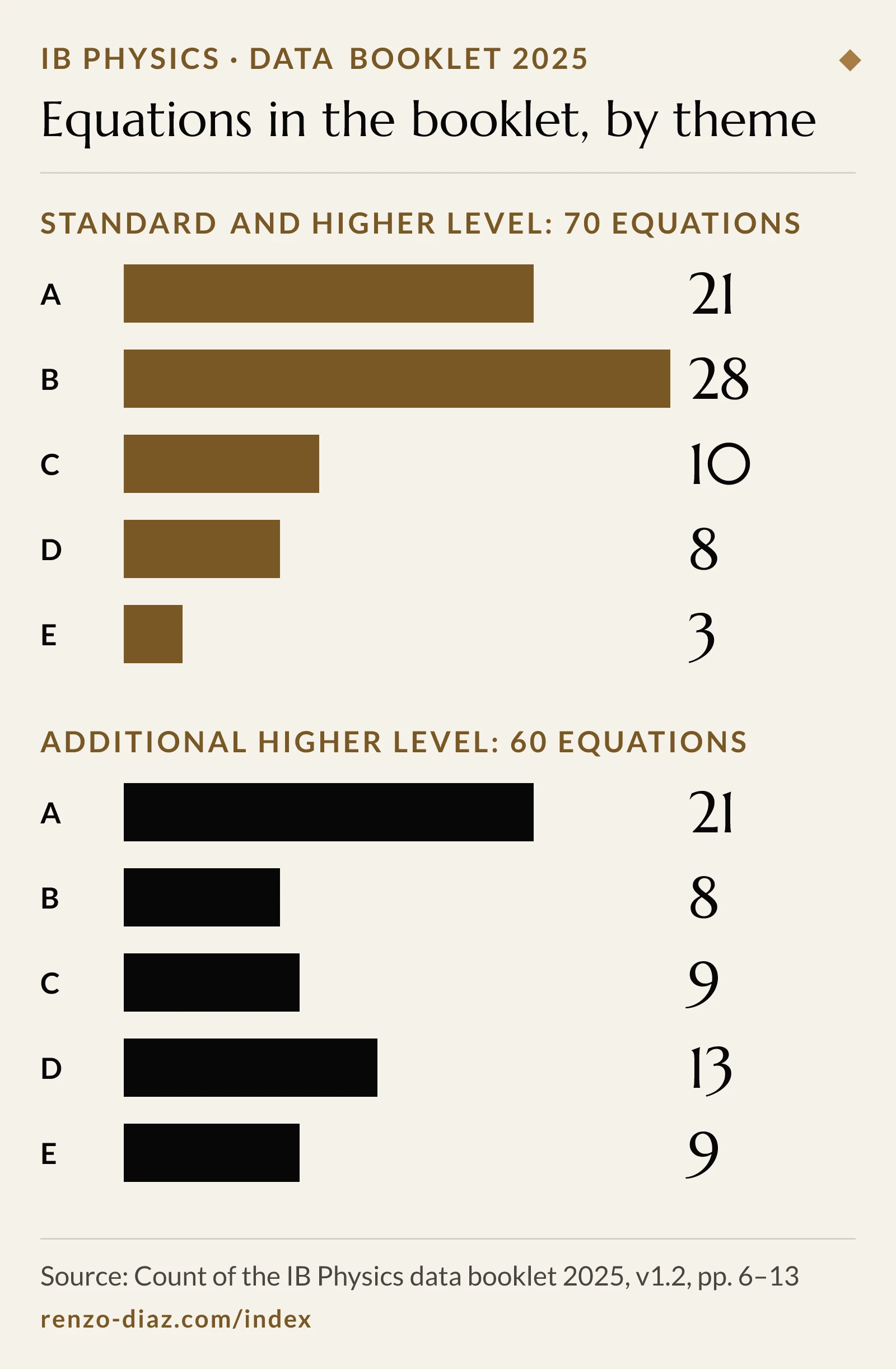
Each theme opens with a block headed standard level and higher level, which every student uses, followed by an additional higher level block for HL students only. I counted every equation printed on the theme pages: 130 in all. A line with a chain of equal expressions, such as Newton's second law written two ways, counts once; the series and parallel circuit rules count as six; each named condition, such as constructive and destructive interference, counts separately.
| Theme | SL and HL | HL only | Total |
|---|---|---|---|
| A. Space, time and motion | 21 | 21 | 42 |
| B. The particulate nature of matter | 28 | 8 | 36 |
| C. Wave behaviour | 10 | 9 | 19 |
| D. Fields | 8 | 13 | 21 |
| E. Nuclear and quantum physics | 3 | 9 | 12 |
| All themes | 70 | 60 | 130 |
My count of the IB Physics data booklet (first assessment 2025), version 1.2, pp. 6–13; version 1.0 gives the same counts. Counted 7 October 2026.
What the counts show
Theme B prints the most equations for every student, 28, because circuits alone account for 12. Theme E prints only three at SL: the photon energy, mass-energy equivalence and the definition of the parsec. The rest of SL nuclear physics is worked from understanding, and SL half-life questions use whole numbers of half-lives; the decay law and the decay constant are HL only.
Two topics print nothing at all: C.4, standing waves and resonance, and E.4, fission. HL adds 60 equations, and 21 of them belong to theme A, where rigid body mechanics and relativity are HL only. The five HL-only topics are set out in IB Physics HL vs SL.
What the booklet does not tell you
The booklet lists equations; it does not explain them. The theme pages give no key to the symbols, no conditions of use and no definitions. That leaves three gaps to fill from the course.
The first is that one letter can stand for several quantities. The booklet uses ordinary physics notation, and ordinary physics notation reuses letters.
| Symbol | Meanings in the booklet |
|---|---|
| L | Angular momentum (A.4); length (A.5, B.5, D.3, D.4); specific latent heat (B.1); luminosity (B.1) |
| n | Refractive index (C.3); amount of substance in moles (B.3); a whole number in interference and diffraction (C.3); principal quantum number (E.1) |
| A | Area (B.1, B.3, B.5, D.4); activity (E.3); nucleon number (E.1) |
| k | Spring constant (A.2, A.3); thermal conductivity (B.1); Coulomb constant (D.2) |
| R | Resistance (B.5); gas constant (B.3); nuclear radius (E.1) |
| r | Radius (A.2, A.4); distance between two masses or charges (D.1, D.2); internal resistance (B.5) |
| η | Viscosity (A.2); efficiency (A.3, B.4) |
| ρ | Density (A.2, B.1, B.3); resistivity (B.5) |
| λ | Wavelength (C.2, C.3, E.2); decay constant (E.3) |
| Φ | Magnetic flux (D.4); work function (E.2) |
| P | Power (A.3, B.5); pressure (B.3) |
| I | Current (B.5, D.3); moment of inertia (A.4) |
| T | Period (A.2, C.1); temperature (B.1, B.3, B.4) |
My reading of the IB Physics data booklet (first assessment 2025), version 1.2, pp. 6–13. Symbols with a subscript, such as kB or Ek, are left out. Checked 7 October 2026.
Conditions and relationships the page does not print
The second gap is the conditions under which an equation holds. The four kinematics equations assume constant acceleration, and the booklet does not say so. The adiabatic relationship for a gas applies, in the course, to monatomic ideal gases. The booklet also states that its equations relate to magnitudes only, without vector notation, so direction comes from the physics; a few equations still carry a minus sign that encodes it, such as the restoring force of a spring, the acceleration in simple harmonic motion and the induced emf.
The third gap is relationships the course asks for but the booklet does not print, because they follow from one that it does. The guide lists the critical angle and total internal reflection beside Snell's law, and the booklet prints only Snell's law: the critical angle is worked out from it. Conservation of momentum and of energy are principles rather than printed equations.
Check your copy
Two lines changed after the first printing
Version 1.0 of the current booklet (February 2023) has the same 130 theme equations as version 1.2, but two lines differ: version 1.2 writes efficiency in words, as useful work or power out over total work or power in, and adds a minus sign to the thermal conduction equation. The version number is on the cover.
How to use the booklet in an exam
Familiarity with the booklet is a skill like any other, and it is built during the course, not in the week before the exam.
Five habits that make the booklet fast to use
Learn the map, not the equations
The theme pages follow the syllabus codes, from A.1 Kinematics to E.5 Fusion and stars. Knowing which topic an equation belongs to is what lets you find it in seconds.
Revise with a clean copy
From the start of revision, use an unannotated copy of the current version, so the pages you search under time pressure look exactly like the ones in the exam.
Know which block is yours
SL students work from the standard and higher level blocks; HL students need both blocks of every theme.
Read the symbols against the question
Before substituting, say what each letter means in this question. The table of shared letters above is the list to check.
Write the equation, then substitute with units
Writing the equation in the form you use, before the numbers, shows your physics and catches a wrong symbol before it costs the result.
If your copy looks different
The booklet for the previous course, first assessed in 2016, is a different document, and it still circulates. It is organised by core topics 1 to 8, additional higher level topics 9 to 12 and four options, A to D, so the same letter means different things: option A there was relativity, while theme A now is space, time and motion.
Its circuit symbols differ too. The old booklet includes an ac supply, a transformer, a diode and a capacitor; the current one has none of these and adds a light-emitting diode, a motor and an earth connection. That matches the current guide, which states that alternating current circuits are not required. For the current course, revise only with the booklet marked first assessment 2025.
Terms used in this article
- Data booklet
- The IB's reference document for a science course, with its constants, symbols and equations, used during the course and in the exams.
- Clean copy
- A copy of the booklet with no notes or marks added, which is what each student has in the exam.
- Theme
- One of the five parts of the current Physics syllabus, A to E, each divided into numbered topics such as A.1 Kinematics.
- Additional higher level (AHL)
- Content studied by HL students only; in the booklet, the second block of each theme.
- First assessment 2025
- The label of the current Physics course, whose first exams were sat in May 2025. Documents for the previous course are labelled first assessment 2016.
Questions about the IB Physics data booklet
Is the IB Physics data booklet provided in the exam?
Yes. Each student must have a clean copy of the booklet in every exam paper, at SL and HL, and the school is responsible for providing enough copies.
Where can I get the IB Physics data booklet 2025?
From your school. The IB makes the booklet available to schools through its own systems, and the school downloads and prints it. Ask your Physics teacher for the current version, which is 1.2.
Can I take my own annotated booklet into the exam?
No. The rule is a clean copy for each student, provided by the school, so notes added to your own copy do not come into the exam with you.
How many equations are in the IB Physics data booklet?
130 on the theme pages, by my count of version 1.2: 70 for SL and HL, and 60 more for HL only. The general pages add mathematical equations, uncertainty rules, 17 constants, 14 SI prefixes and 7 unit conversions.
Do I need to memorise any equations for IB Physics?
Fewer than you might expect, but the booklet is not the whole story. What each symbol means, the conditions under which an equation holds, and relationships that follow from printed ones, such as the critical angle from Snell's law, come from the course itself.
Is the 2025 data booklet different from the old one?
Yes, it is a different document. The current booklet is organised by themes A to E with an HL block in each; the old one by topics 1 to 12 and options A to D. The circuit symbols changed as well.
Written by
Teaching IB since 2016. Seven years of IB reviews you can check on Google — and named results with the documents behind them.
Last reviewed October 7, 2026
Sources
The description and every count come from the IB Physics data booklet for the current course (first assessment 2025), read in version 1.2 (updated November 2023) and compared with version 1.0 (February 2023); the rules for its use from the IB Physics guide for the same course; the comparison from the booklet for the previous course (first assessment 2016). The IB makes these documents available to schools; they are paraphrased and counted here, never reproduced. Checked on 7 October 2026.