RENZO DIAZ — Reference library
IB Physics 2025 Exams: Which Topics Carried the Marks
4 min readBy Renzo DiazLast reviewed October 7, 2026
I counted every mark of the 2025 IB Physics exams, the first sittings of the current course, by syllabus theme. In Papers 1A and 2, each theme's share of the HL marks was within one percentage point of its share of the HL teaching hours, and at SL within 3.4 points. Almost every topic was examined in every sitting. Paper 1B was different: 79 of its 100 marks across the five 2025 papers were for data skills, set in thermal and gas contexts more often than any other.
"Which topics come up most?" is one of the first questions families ask about IB Physics, and the current course, first examined in May 2025, had no exam history to answer it with. So I counted. Every mark of every 2025 paper went to the one syllabus topic it mainly assessed, and the totals were set against the teaching hours the IB Physics guide recommends for each theme.
The result is less exciting than a list of "hot topics", and more useful: the papers were built in proportion to the course. The one paper that behaves differently, Paper 1B, does so for a reason worth planning around.
The papers were built in proportion to the course. Revise the course, not a forecast.
Key takeaways
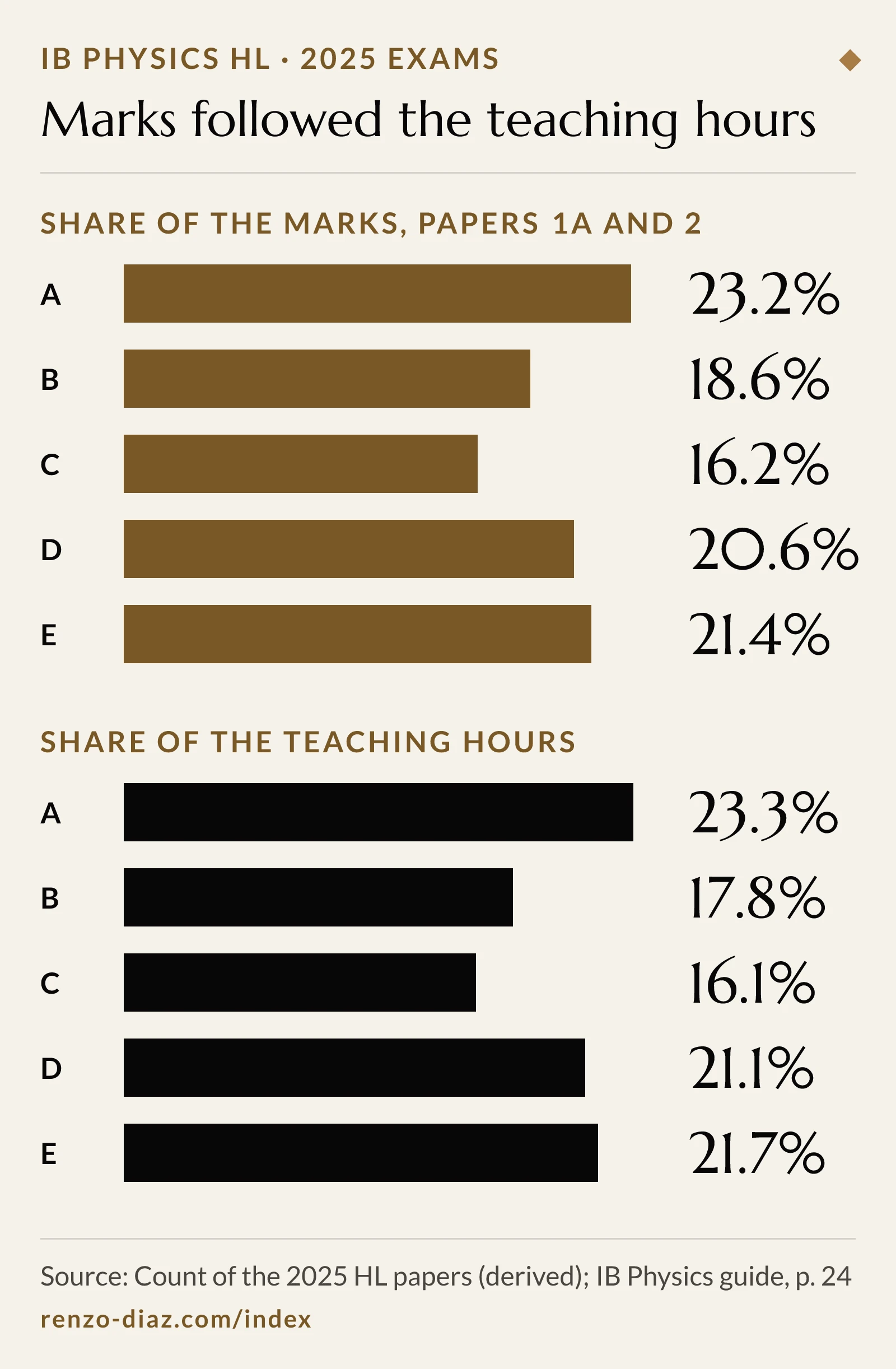
- Marks followed the hours: in Papers 1A and 2, the HL themes took 23.2%, 18.6%, 16.2%, 20.6% and 21.4% of the marks against 23.3%, 17.8%, 16.1%, 21.1% and 21.7% of the teaching hours.
- Nothing was safe to skip: at HL, all 24 topics carried marks in four of the five sittings; at SL, no sitting left out more than two of the 19 topics.
- Paper 1B is a data paper: 79 of its 100 marks in 2025 were for data skills, and 42 of the 100 were set in thermal or gas contexts.
- HL-only topics: 129 of the 750 HL marks (17.2%), close to their 20.6% share of the HL content hours.
- One sitting can tilt: at SL, theme A took anywhere from 17.3% to 28.0% of a sitting's Paper 1A and Paper 2 marks.
What was counted, and how
The count covers the 2025 sittings of the current course: May 2025 in three time zones and November 2025 in two, each at SL and HL. Each sitting has Paper 1A (multiple choice), Paper 1B (data-based) and Paper 2. Paper 1B was the same paper at SL and HL in every 2025 sitting, so the count covers 25 distinct papers: 762 mark-bearing items and 1,125 marks. Counted per level, that is 475 SL marks and 750 HL marks.
Each multiple-choice question carries one mark; in Papers 1B and 2, each lettered part carries the marks printed beside it. Every item went to the one topic, out of the 24 in the guide, that its marks are mainly for. Where an item draws on two topics, it counts once, under the main one. Every paper's count adds up to its printed maximum, and a sample of the classifications was re-checked by hand.
The count at a glance
- Sittings
- 5
- May 2025 TZ1, TZ2 and TZ3; November 2025 TZ1 and TZ3.
- Distinct papers
- 25
- Paper 1B is shared by SL and HL.
- Marks classified
- 1,125
- 762 items, each assigned to one syllabus topic.
- Low-confidence calls
- Under 4%
- 2.9% of SL marks and 3.7% of HL marks.
How to read the numbers
Themes are solid; single topics are softer
A question on a collision that also asks about energy, or a star question that uses the black-body laws, sits between two topics. Those calls move marks between neighbouring topics, but almost never between themes, so the theme shares below are the robust result and the topic ranking is indicative.
Papers 1A and 2 followed the teaching hours
The IB Physics guide recommends 110 hours of syllabus content at SL and 180 at HL, split across five themes. In the content papers, Paper 1A and Paper 2, the marks landed almost exactly where the hours are. At HL, no theme was more than 0.8 of a percentage point away from its share of the hours. At SL the fit was looser but still close: theme A, space, time and motion, was the furthest off, with 21.1% of the marks against 24.5% of the hours.
That is the most useful single fact for planning revision: the time the course spends on a theme is a good guide to the marks it will carry.
| Theme | HL marks | HL hours | SL marks | SL hours |
|---|---|---|---|---|
| A. Space, time and motion | 23.2% | 23.3% | 21.1% | 24.5% |
| B. The particulate nature of matter | 18.6% | 17.8% | 23.5% | 21.8% |
| C. Wave behaviour | 16.2% | 16.1% | 17.9% | 15.5% |
| D. Fields | 20.6% | 21.1% | 17.3% | 17.3% |
| E. Nuclear and quantum physics | 21.4% | 21.7% | 20.3% | 20.9% |
Marks: my count of the 2025 Papers 1A and 2, 650 HL marks and 375 SL marks. Hours: the IB Physics guide (first assessment 2025), syllabus outline, p. 24, syllabus content only (180 hours at HL, 110 at SL). Counted and checked 7 October 2026.
Almost every topic was examined in every sitting
Counting by sitting tells the same story from another angle. At HL, every one of the 24 topics carried marks in four of the five sittings; the fifth left out a single topic. At SL, the 19 topics were all examined in two sittings, and no sitting left out more than two. There was no topic a student could have skipped and been sure of losing nothing.
What did move from one sitting to the next was the weight. At SL, theme A took 17.3% of one sitting's Paper 1A and Paper 2 marks and 28.0% of another's. A student who sits one paper is sitting one draw from that spread, which is why the full course matters more than any pattern in past papers.
| Theme | SL range | HL range |
|---|---|---|
| A. Space, time and motion | 17.3% to 28.0% | 20.0% to 24.6% |
| B. The particulate nature of matter | 20.0% to 26.7% | 15.4% to 23.8% |
| C. Wave behaviour | 14.7% to 21.3% | 13.8% to 18.5% |
| D. Fields | 13.3% to 21.3% | 17.7% to 23.8% |
| E. Nuclear and quantum physics | 16.0% to 24.0% | 19.2% to 23.8% |
My count of the 2025 Papers 1A and 2: 75 marks per SL sitting and 130 per HL sitting. Counted 7 October 2026.
The topics that carried the most marks
Across all three papers, two topics stood out at both levels: forces and momentum, and thermal energy transfers. The second is larger than its teaching hours suggest for two reasons. The guide places the black-body laws and density there, so star questions that use the black-body laws count as thermal energy transfers, and so does a data-based question built on density measurements.
| Rank | SL topic | SL marks | HL topic | HL marks |
|---|---|---|---|---|
| 1 | B.1 Thermal energy transfers | 63 (13.3%) | A.2 Forces and momentum | 75 (10.0%) |
| 2 | A.2 Forces and momentum | 57 (12.0%) | B.1 Thermal energy transfers | 65 (8.7%) |
| 3 | B.3 Gas laws | 34 (7.2%) | E.3 Radioactive decay | 49 (6.5%) |
| 4 | D.3 Motion in electromagnetic fields | 32 (6.7%) | D.3 Motion in electromagnetic fields | 48 (6.4%) |
| 5 | C.3 Wave phenomena | 31 (6.5%) | C.3 Wave phenomena | 45 (6.0%) |
| 6 | E.3 Radioactive decay | 31 (6.5%) | B.3 Gas laws | 39 (5.2%) |
My count of all 2025 papers: 475 SL marks and 750 HL marks, Paper 1B included. Topic codes and names from the IB Physics guide (first assessment 2025). Counted 7 October 2026.
Paper 1B is a data paper
Paper 1B is worth 20 marks at both levels and, in 2025, it was the same paper at SL and HL. Of its 100 marks across the five sittings, 79 were for data skills: reading and plotting graphs, gradients and intercepts, uncertainties, and evaluating or improving a method. A single paper ranged from 11 to 18 data-skill marks out of 20.
The physics around those skills came from gases and thermal physics more often than anything else: 42 of the 100 marks were set in those contexts. That is why theme B looks larger when Paper 1B is included. It is a context, not a content load: the marks are for handling the data.
| Topic | Marks out of 100 |
|---|---|
| B.3 Gas laws | 22 |
| B.1 Thermal energy transfers | 20 |
| C.3 Wave phenomena | 15 |
| B.5 Current and circuits | 11 |
| A.2 Forces and momentum | 11 |
| E.3 Radioactive decay | 7 |
| D.2 Electric and magnetic fields | 6 |
| A.1 Kinematics | 6 |
| C.1 Simple harmonic motion | 2 |
My count of the five 2025 Paper 1B papers (May TZ1 to TZ3, November TZ1 and TZ3), 20 marks each. Counted 7 October 2026.
How much the HL-only topics weighed
Five topics have no SL content at all: rigid body mechanics, Galilean and special relativity, thermodynamics, induction and quantum physics. Together they are 37 of the 180 HL content hours, or 20.6%. In the 2025 HL papers they carried 129 of the 750 marks, 17.2%. Paper 1B, being shared with SL, carried none of them, so in Papers 1A and 2 alone their share was 19.8%, almost exactly their share of the hours. Sitting by sitting, it ranged from 20 to 33 marks out of 150.
What this means for revision
A count of past papers says how the marks were spread, not which question comes next. Read that way, the 2025 papers support a plain plan.
Revising with the 2025 count in mind
Spread revision time like the guide's hours
In Papers 1A and 2 the marks followed the hours closely, so a theme's share of the course is a sound share of revision time.
Leave no topic out
Almost every topic was examined in every sitting. Skipping one to save time is a bet the 2025 papers did not reward.
Train data skills as a skill
Paper 1B is mostly graphs, gradients, uncertainties and method. Practise them on their own, in unfamiliar contexts, rather than hoping topic revision covers them.
At HL, give the HL-only topics their fifth
Rigid body mechanics, relativity, thermodynamics, induction and quantum physics carried close to a fifth of the content marks, in line with their hours.
Practise whole sittings
A single sitting can lean several points towards one theme. Full timed papers prepare a student for that variation; topic drills alone do not.
Terms used in this article
- Sitting
- One exam session for one time zone, such as May 2025 TZ2. A large-entry subject sits different papers in different time zones.
- Paper 1A
- The multiple-choice part of Paper 1: 25 one-mark questions at SL, 40 at HL.
- Paper 1B
- The data-based part of Paper 1, worth 20 marks. In 2025 it was the same paper at SL and HL.
- Theme
- One of the five groups the syllabus is organised in: A space, time and motion; B the particulate nature of matter; C wave behaviour; D fields; E nuclear and quantum physics.
- Data skills
- Marks for handling evidence rather than recalling physics: reading and plotting graphs, gradients and intercepts, uncertainties, and evaluating or improving a method.
Questions about the 2025 IB Physics exams
Which topics come up most in the IB Physics exams?
In 2025, forces and momentum and thermal energy transfers carried the most marks at both levels. Theme by theme, though, the marks in Papers 1A and 2 followed the teaching hours closely, and almost every topic was examined in every sitting.
Is IB Physics Paper 1B the same at SL and HL?
Yes, in every 2025 sitting. Paper 1B is worth 20 marks at both levels, and 79 of its 100 marks across the five 2025 papers were for data skills.
How much of the IB Physics HL exam is HL-only content?
About a fifth of the content marks. The five HL-only topics carried 129 of the 750 HL marks in 2025 (17.2%), and 19.8% of the Paper 1A and Paper 2 marks, against 20.6% of the HL content hours.
Can you predict the topics on the next IB Physics paper?
No. The 2025 papers show how the marks were spread, not which questions come next, and a single sitting moved by several points from the average. The reliable plan is to revise the whole course in proportion to its teaching hours.
Which papers does this count cover?
All the 2025 papers of the current course. May 2025 in time zones 1 to 3 and November 2025 in time zones 1 and 3, at SL and HL: Papers 1A, 1B and 2, 25 distinct papers and 1,125 marks.
Written by
Teaching IB since 2016. Seven years of IB reviews you can check on Google — and named results with the documents behind them.
Last reviewed October 7, 2026
Sources
The marks are my own count of the 2025 IB Physics papers (May 2025 TZ1 to TZ3, November 2025 TZ1 and TZ3, SL and HL), held on file. The papers are not reproduced, quoted or paraphrased here: only totals by topic and theme are published. Each item was assigned to one of the 24 topics of the IB Physics guide (first assessment 2025), which is also the source of the teaching hours (p. 24) and of the topic names. The classification is a judgement: 2.9% of the SL marks and 3.7% of the HL marks were low-confidence calls, and a sample was re-checked by hand. Counted on 7 October 2026.