How I work.
Renzo Diaz's teaching method starts by locating the exact point where a student's reasoning broke down — often several topics behind where the class has moved on — then rebuilds from there through a fixed weekly rhythm: live problem-solving each session, targeted timed practice between sessions, and every session recorded into a searchable archive across the full IB cycle. This is the method behind a documented Grade 3 to Grade 7 in IB Math AI SL, stated openly in a public Google review. That diagnostic speed is backed by a documented WAIS-IV evaluation putting Renzo's own processing speed in the 99th percentile.
Most tutoring reacts to the question in front of the student. I reverse-engineer the error. That works when they simply missed a lesson. It fails completely when the real problem started three chapters earlier — or when they know the method but can't recognise when to use it.
The work here is different: find where the reasoning broke, rebuild the missing understanding, train it on problems they have never seen before, and carry that work from one week into the next.
1 · Start where it broke
Locate the fault line — not the current chapter.
Before anything else, I find the gap. When a student explains their confusion, I am not listening for the wrong answer — I am listening for the exact step where their reasoning came apart. That point is almost never where they think it is, and it is often several topics behind where the class has moved on to.
We go back as far as the structural damage requires. Not to redo the year, but because rebuilding on a cracked foundation is exactly why capable students keep plateauing — regardless of how many hours they put in.
This is the difference between patching the exercise in front of them and closing the gap that keeps producing the same mistake.
2 · Understanding you can carry
Understanding you can carry into a problem you have never seen.
The IB is an anti-pattern exam. It does not reward the study method that works everywhere else — drilling one problem type until you've mastered it. The IB will always ask something different: the same core concepts, placed in a situation your child has never seen before. It does not test whether they can repeat. It tests whether they understood deeply enough to apply.
So the work is not volume. It is precision. We build the exact skill the exam actually measures: reading an unfamiliar problem, recognising what is really being asked, and choosing the right tool.
Concretely, that means explaining through analogy and structure rather than formulas to memorise — so that what they learn holds up when the question changes shape. A student who has understood something can rebuild it under pressure. A student who memorised it cannot.
And there is a second layer most tutoring never touches: the IB is a timed exam. Knowing a method is not the same as choosing the fastest correct one. A student can reach the right answer in six minutes and still lose the paper — because those six minutes were owed to the next question.
The part that still has to belong to the student
Knowing the method is not the same as knowing when to use it.
AI can solve a problem and explain a method. The student's job is different: recognise what the problem is really asking, decide which method fits, know when a familiar approach is too slow, and reproduce the reasoning without the help.
That is why the goal is never to make the student better at following solutions. It is to make them better at making decisions.
What a week actually looks like.
The work runs on a set weekly rhythm, not ad-hoc bookings.
In session
We work on what is live from school — the problems they are stuck on right now — and advance systematically through the syllabus so we are never only reacting. Time is spent per topic according to what the student actually needs, not a fixed plan: some concepts take ten minutes, some take three sessions. Everything is taught visually on a shared digital whiteboard, so your child follows the reasoning being built, step by step, rather than watching a finished answer appear.Between sessions
Targeted practice — past papers and exam-style questions chosen for the specific gaps we are working on. Done properly: timed, the way the exam will actually feel, because accuracy without pace is only half the skill the IB grades.Next session
We open with their incorrect answers. That closes the loop: the next session starts from evidence of what happened in the last one.
Consistency matters
The #1 reason smart kids fail: Inconsistency.
A brilliant method is useless if the student resets every Monday. The fixed weekly rhythm is non-negotiable: it creates the external structure that turns isolated understanding into repeatable exam performance. We do not do ad-hoc rescue missions the night before a test.
Sessions run one or two times a week, set at intake based on level and exam timeline.
4 · Why it's repeatable
The Diagnostic Loop: A consistent system. An individual intervention.
The method stays consistent. What changes is what the student needs from it.
The sequence is locked: Diagnose the fault → Rebuild the logic → Test against unfamiliar problems → Review the errors → Adjust the next intervention. Every session is recorded and summarised, so the work compounds across the IB cycle instead of resetting each week.
That is what makes the programme systematic without making it rigid: the process stays reliable, while the intervention changes around the student.
You always know exactly where your child stands.
Every session is recorded and summarised. Your child keeps a searchable archive of every concept they have worked through — building, across the IB cycle, into a personal library they can return to before any exam.
For you, it ends the "how did it go?" guessing game. You can see exactly what was covered, what is improving, and what remains open — without relying on a teenager's summary.
For your child, it means nothing is lost. A concept explained in October is still there, in the form it made sense to them, in May.
Technical setup
Every session runs over Zoom on a recurring weekly slot. We share an Excalidraw whiteboard where the maths and physics get worked out in real time, so the reasoning is visible as it's built, not just the finished answer. Most students use an iPad or a graphics tablet for this; when neither is available, I write while they verbalise their reasoning aloud. Every session is recorded and summarised, so nothing is lost between weeks.
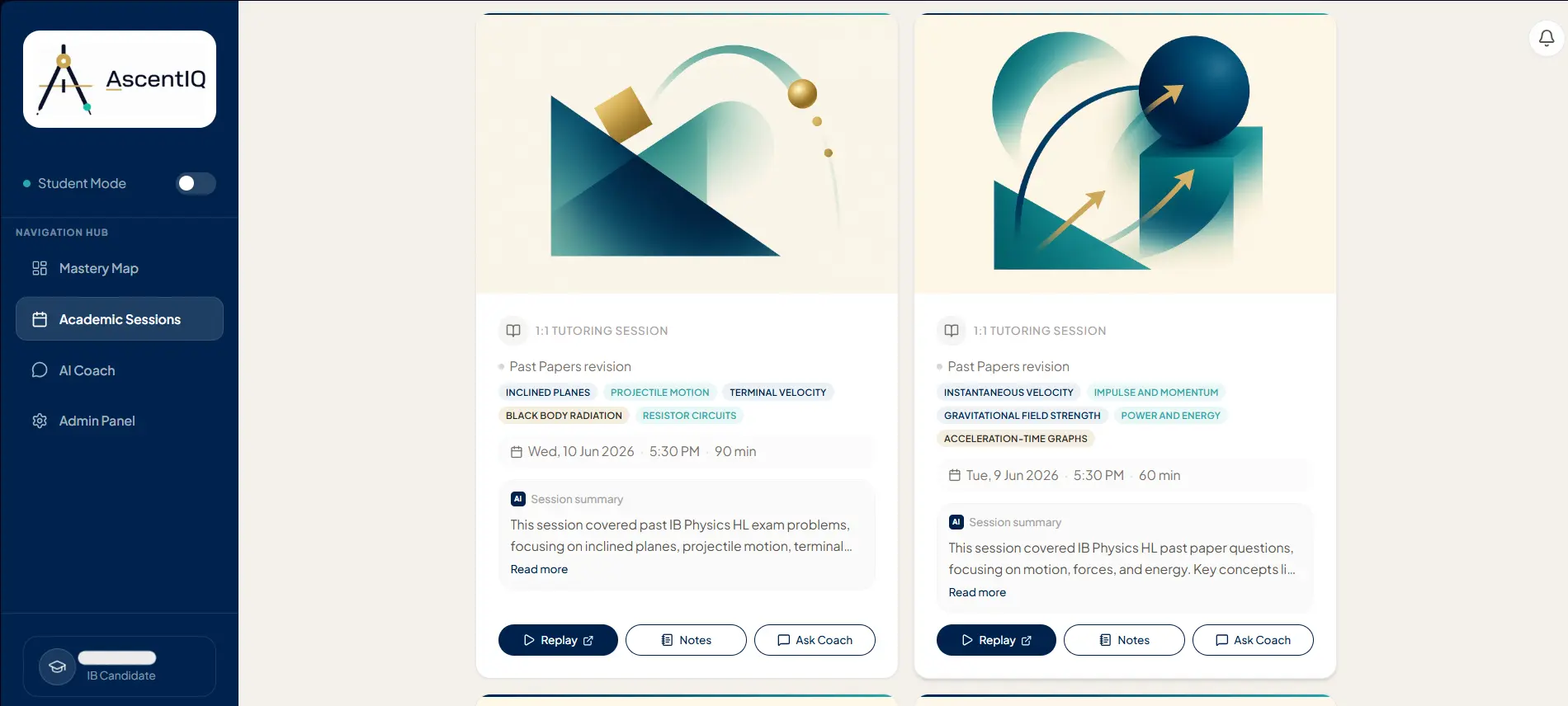
The session archive — every session recorded and summarised, searchable by topic. 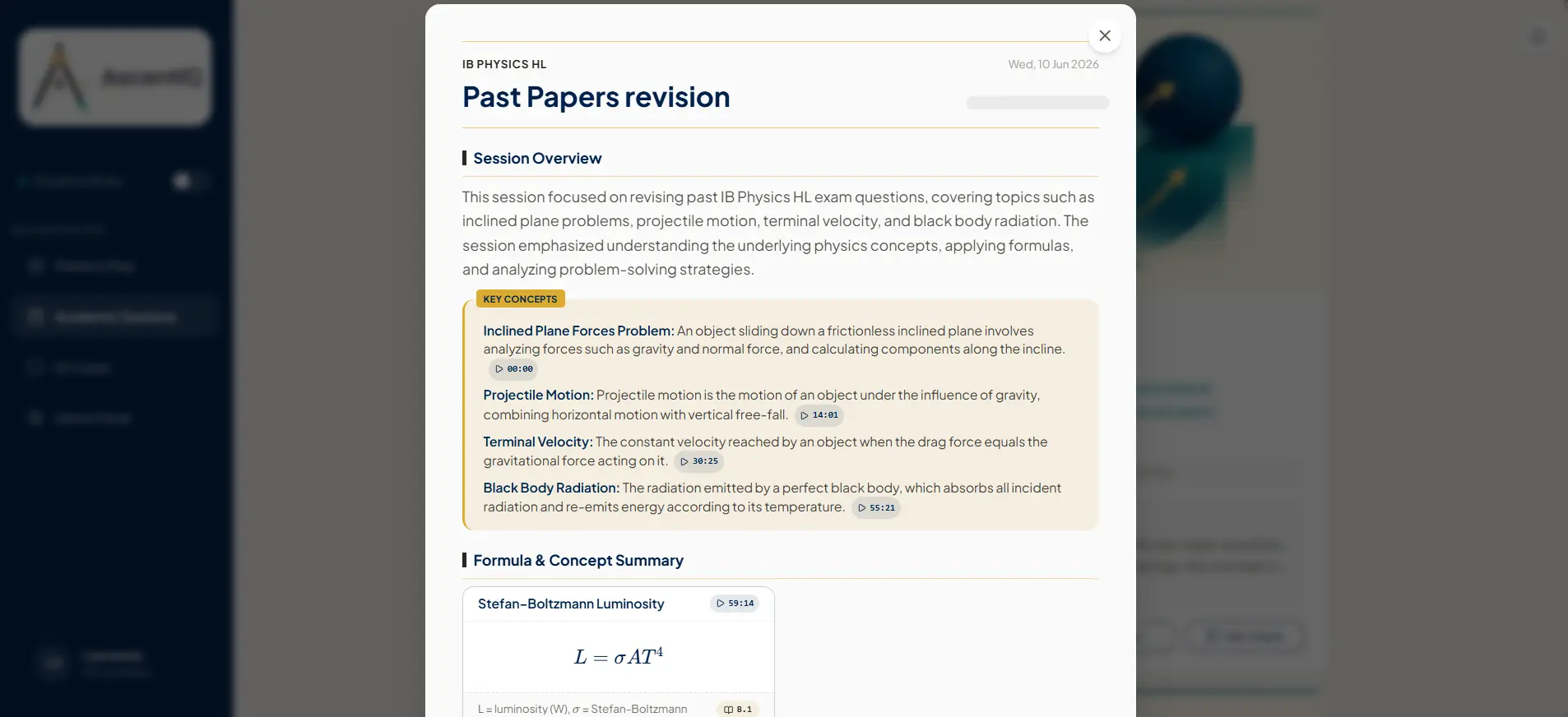
Inside a session summary — key concepts, each linked to its moment in the recording. 6 · How it starts
The Diagnostic Mapping (Not a sales call).
Every engagement starts with a Diagnostic Mapping. I need to see the shape of the gaps — not just their report card — before I say if I can help and what the intervention would look like.
If I don't believe the system will move your child meaningfully, I will tell you in the first 15 minutes. I'd rather lose a client than take on a failure case. What that looks like when it works: a documented Grade 3 to Grade 7, stated openly in a public Google review —