RENZO DIAZ — Reference library
IB Math AA HL Papers: Format, Marks and a Better Revision Plan
5 min readBy Renzo DiazLast reviewed October 7, 2026
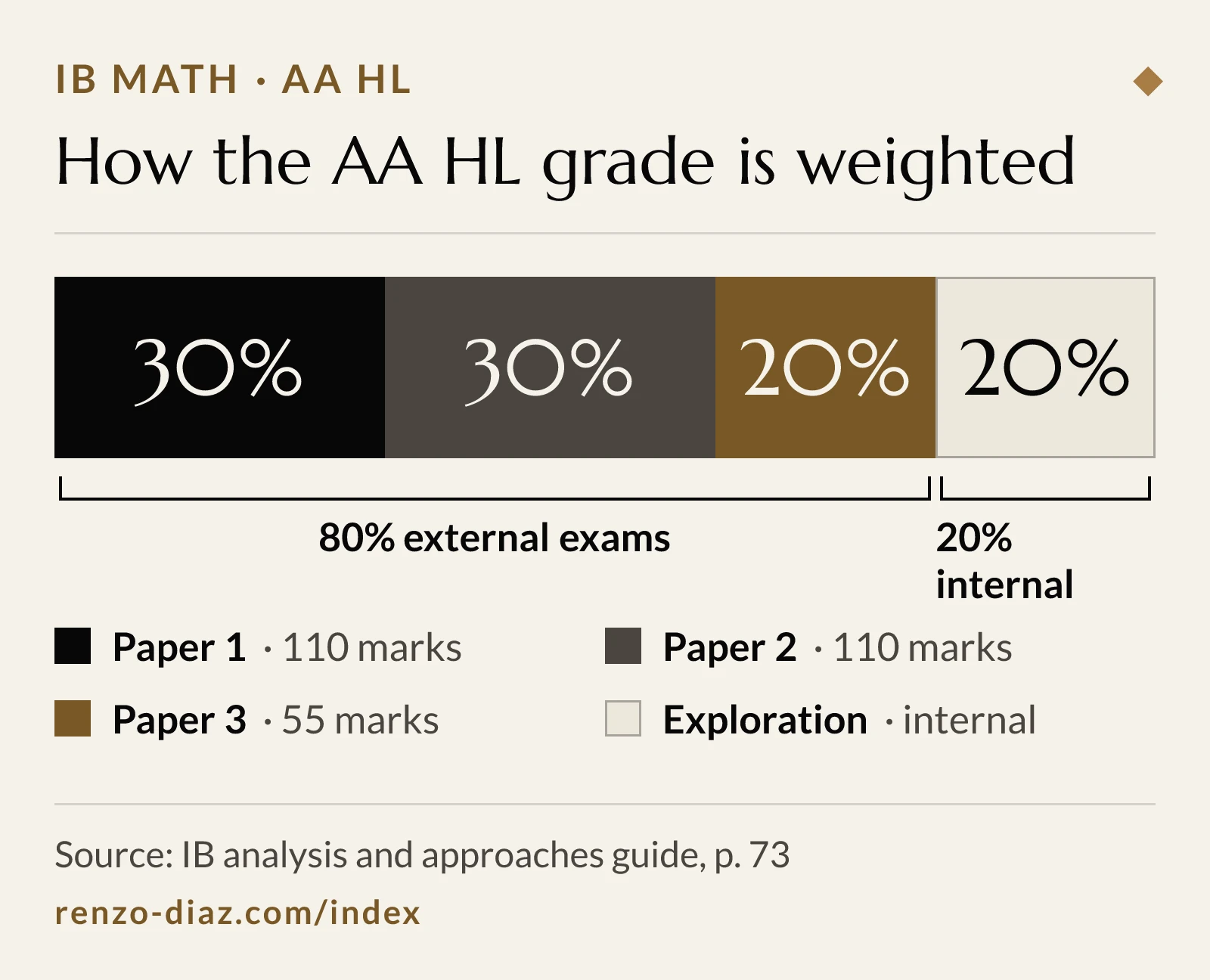
AA HL is assessed by three written papers and a mathematical exploration. Paper 1 (2 hours, 110 marks, 30%) allows no calculator; Paper 2 (2 hours, 110 marks, 30%) and Paper 3 (1 hour 15 minutes, 55 marks, 20%) require a graphic display calculator; the exploration is the remaining 20%. These are the rules of the current course, examined for the last time in November 2028. The revised course is first examined in May 2029, with fewer marks per paper.
A student preparing for AA HL needs more than a list of topics. They need to know what each paper tests, how long they have, and how marks are awarded beyond the final answer. Confusing the current paper format with the one coming in 2029, or leaving the method off the page and staking everything on the final number, both produce a weaker revision plan than the exam demands.
A correct answer with no working is not guaranteed full marks. The working on the page is what still earns marks when the answer is wrong.
Key takeaways
- Papers 1 and 2: two hours each, 110 marks each, 30% of the grade each. Paper 1 allows no calculator; Paper 2 requires one.
- Paper 3: one hour 15 minutes, 55 marks, 20% of the grade, built on two compulsory extended problems.
- The exploration: 20% of the grade, marked by the teacher and moderated by the IB.
- Working earns marks: a correct answer with no working is not guaranteed full marks, and a wrong answer with the correct method written down can still score.
- From May 2029: Papers 1 and 2 drop to 100 marks, and Paper 3 to 50 marks and one hour.
What each paper actually tests
Paper 1 is the no-calculator paper: two hours, 110 marks and 30% of the final grade, with compulsory short-response questions in Section A and compulsory extended-response questions in Section B, drawn from all five syllabus areas. Its distinctive constraint is that a graphic display calculator cannot do the algebra or the numerical checking for you. Paper 2 has the same shape, the same 110 marks and the same 30%, and a GDC is required. Paper 3 is different in kind: two compulsory extended-response problem-solving questions, 55 marks and 20% of the grade, again with a GDC. The mathematical exploration, an individual piece of written work marked by the teacher and moderated by the IB, is the remaining 20%.
Paper 3's time is worth checking at the source rather than in an older document. The subject guide for first assessment in 2021 printed it as 60 minutes; the IB's current page on the course updates gives the current Paper 3 as one hour 15 minutes, and says it returns to one hour in the revised course. Revising against the wrong time allowance produces the wrong exam plan for a live exam.
| Component | Time | Marks | Weight | Calculator |
|---|---|---|---|---|
| Paper 1 | 2 hours | 110 | 30% | Not allowed |
| Paper 2 | 2 hours | 110 | 30% | GDC required |
| Paper 3 | 1 hour 15 minutes | 55 | 20% | GDC required |
| Mathematical exploration | Coursework | 20 | 20% | Not applicable |
Sources: the IB's Mathematics: analysis and approaches guide (first assessment 2021), assessment outline and external assessment details, pp. 73–79; the current Paper 3 time from the IB's AA updates page. Checked 7 October 2026.
Working is what protects your marks when an answer goes wrong
The subject guide is explicit on this point. In Papers 1 and 2, full marks are not necessarily awarded for a correct answer with no working; answers must be supported by working or explanation; and where an answer is incorrect, some marks may be given for a correct method shown in writing. So the risk runs both ways. A bare correct answer can lose marks, a bare wrong answer leaves nothing to award, and the same slip with the method written down still collects the method marks and can carry follow-through marks into later parts. That makes visible working insurance, not ceremony, and in Paper 1, with no calculator to check against, it is the cheapest insurance available. Practise exact forms, transformations, calculus and proof while writing enough intermediate steps for another person to reconstruct the approach without you there to explain it.
The same principle carries into Paper 2, where a calculator can solve an equation or plot an intersection but cannot explain why that operation answers the question being asked. A useful discipline is to record the model or equation used, define the variables, show the relevant calculator output, and interpret the result with correct units and accuracy. Then ask, for every practice question: if the final numerical answer turned out to be wrong, would the remaining working still earn marks? If not, the script is fragile even when the number happens to be right.
If the final number turned out to be wrong, would what's left on the page still earn marks?
Paper 3 has two compulsory problems, and both count
Paper 3 contains two compulsory extended-response problems, and both need a genuine attempt. Treating it as a choice between them leaves real marks unattempted for no reason. The two questions need not carry the same marks: the allocation is printed at the start of each, and how to divide the one hour 15 minutes between them depends on the paper and on the student, which is exactly the judgement timed practice is there to build.
Each question develops a single theme towards a generalisation or the interpretation of a context, and, where possible, opens with a part on syllabus content that leads into it. The useful method is the one mathematicians actually use: make a conjecture, test it against a small case, then justify the general step. If a later part is genuinely out of reach, writing down the partial structure already reasoned through and moving on captures marks that abandoning the problem entirely would lose.
A review loop that targets the actual failure point
Marking a practice paper against the correct scheme is the easy part. The more useful step is recording marks lost by reason, not just by topic: course knowledge, choice of method, algebra, notation and time management are different problems with different fixes, and lumping them together as "calculus mistakes" hides which one actually needs work.
A four-step review loop
Sit one paper under real timed conditions
Use the syllabus and the exam session that apply to your own cohort, and the time allowance of the current course.
Mark it and record marks lost by reason
Knowledge, method choice, algebra, notation or time: one reason per lost mark.
Redo two missed questions without the solution
Explain aloud why each method works, not just what it does.
A week later, try an unfamiliar question on the same idea
This is the real test. Recognising a worked solution you have already seen is not the same skill as producing the method again, unprompted, on something new, and that transfer is what the exam checks.
Recognising a method you've already seen is not the same skill as producing it again, unprompted, on a new problem.
Which version applies to you
The IB has confirmed that the current mathematics courses have their final assessment in November 2028. The revised course begins teaching in August 2027, with its first assessment in May 2029, so two Diploma cohorts starting in consecutive years sit genuinely different exams. In the revised AA HL course, Papers 1 and 2 drop to 100 marks each, and Paper 3 drops to 50 marks and returns to one hour. The exploration moves from the current five criteria to four, built around the IB's mathematical inquiry process, and the revised HL course removes some content: financial applications, proof by counterexample, bivariate data and Euler's method.
A student starting the Diploma in 2026 and one starting in 2027 need different exam reference material, so check which subject brief and which specimen papers apply to your own cohort before building a study plan around either one.
| Component | Current course (exams to November 2028) | Revised course (first exams May 2029) |
|---|---|---|
| Paper 1 | 110 marks | 100 marks |
| Paper 2 | 110 marks | 100 marks |
| Paper 3 | 55 marks, 1 hour 15 minutes | 50 marks, 1 hour |
| Exploration criteria | Five: presentation, mathematical communication, personal engagement, reflection, use of mathematics | Four: problem specification, abstraction, computation, interpretation |
Sources: the IB's AA updates page (last updated 3 April 2026) for the revised course; the current criteria from the AA guide (first assessment 2021). Checked 7 October 2026.
Two students starting the Diploma one year apart can be sitting genuinely different exams. Check which cohort you belong to before trusting any study guide.
Terms used in this article
- AA HL
- Mathematics: analysis and approaches at higher level, the IB Mathematics course built around algebra, functions, calculus and proof.
- GDC
- Graphic display calculator. Not allowed in Paper 1; required in Papers 2 and 3.
- Mathematical exploration
- The internally assessed component: an individual piece of written work investigating an area of mathematics, marked by the teacher and moderated by the IB, worth 20% of the grade.
- Method marks
- Marks for a correct method shown in writing. They can be earned even when the final answer is wrong.
- Follow-through marks
- Marks for a later step that uses an earlier wrong value correctly.
Questions about the AA HL papers
How long is IB Math AA HL Paper 3?
One hour 15 minutes in the current course. The subject guide for first assessment in 2021 printed 60 minutes; the IB's current updates page gives one hour 15 minutes, and the revised course returns Paper 3 to one hour from May 2029.
Can you use a calculator in AA HL Paper 1?
No. Paper 1 allows no calculator. Papers 2 and 3 require a graphic display calculator.
How much is each AA HL paper worth?
Papers 1 and 2 are 30% each, Paper 3 is 20%, and the exploration is 20%. The three papers together are 80% of the grade and are marked externally.
Do you get marks for working if the final answer is wrong?
Yes, for a correct method shown in writing. The subject guide says some marks may be given for correct method where an answer is incorrect, and that full marks are not necessarily awarded for a correct answer with no working.
When does the new AA HL course start?
Teaching starts in August 2027 and the first exams are in May 2029. The current course is examined for the last time in November 2028, so a student starting the Diploma in August 2027 or later takes the revised course.
Written by
Teaching IB since 2016. IB 7s you can verify in my students’ own Google reviews — and named results with the documents behind them.
Last reviewed October 7, 2026
Sources
Marks, weights, times, calculator rules and the current exploration criteria come from the IB's Mathematics: analysis and approaches guide (first assessment 2021), which the IB makes available to schools. The current Paper 3 time, the revised course and the final assessment date come from the IB's public pages below. All were checked on 7 October 2026; ibo.org blocks some automated requests, so its pages were read in a browser.