RENZO DIAZ — Reference library
IB Math AA or AI: What UK and European Universities Require (2027 Entry)
4 min readBy Renzo DiazLast reviewed October 7, 2026
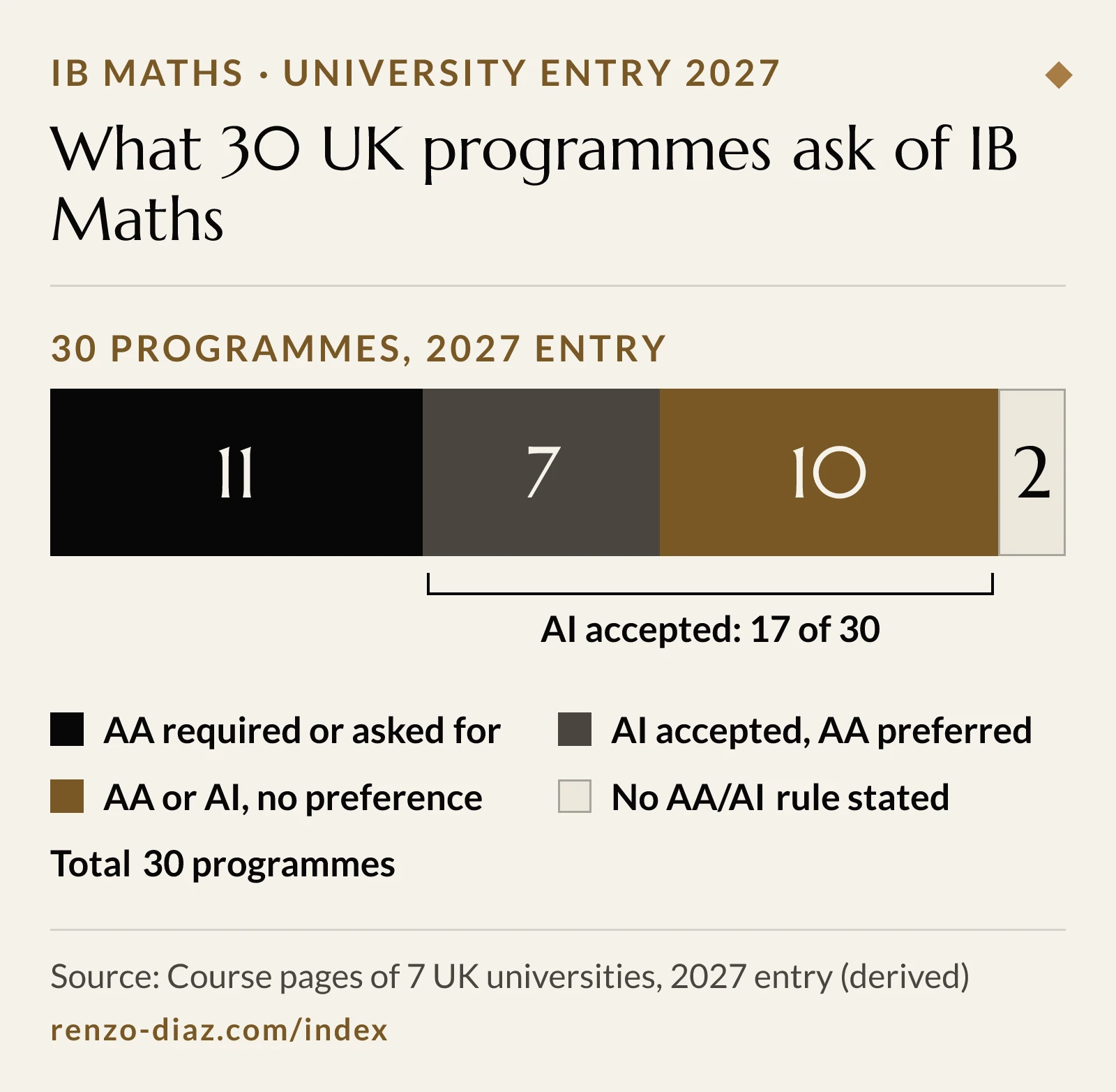
It depends on the university more than on the subject. Of 30 UK programmes in engineering, computer science, economics and physics checked for 2027 entry, 11 require or ask for Mathematics: Analysis and Approaches (AA), 7 accept Applications and Interpretation (AI) but prefer AA, 10 accept either with no preference, and 2 state no rule. Cambridge asks for AA on every course checked; Oxford accepts either at Higher Level for every course that requires Mathematics, except Chemistry. In continental Europe, ETH Zurich, EPFL and German universities accept either at HL, while TU Delft accepts only AA HL.
"Universities prefer AA" is the most repeated claim in the AA-versus-AI debate, and it is too broad to be useful. The same university can require AA for one programme, prefer it for a second and accept either for a third. This article replaces the claim with a count: what 30 programmes at seven UK universities, and the admission rules of six universities and two national systems in continental Europe, actually say for students entering in 2027.
Every row comes from the university's own course or admissions page, read on 7 October 2026. Requirements change every cycle, so the table is a starting point for your shortlist, not a substitute for the page of the course you apply to.
A student should not discover the difference between AA and AI after the subjects are chosen.
Key takeaways
- 30 UK programmes, three policies: 11 require or ask for AA, 7 accept AI with AA preferred, 10 accept either, 2 state no rule.
- Cambridge and Oxford disagree: Cambridge asks for AA; Oxford accepts AI at HL wherever it requires Mathematics, except Chemistry.
- Physics and computer science lean to AA: 3 of the 6 programmes in each require or ask for it.
- Higher Level is the wider line: 28 of the 30 UK programmes require Mathematics at HL, whichever course.
- TU Delft is the strictest in Europe: AA at HL only, for every bachelor programme.
Three policies, counted
Each programme falls into one of three policies, plus a few that say nothing. AA required or asked for: the course names Analysis and Approaches. AI accepted, AA preferred: either meets the requirement, and the page states a preference for AA. AA or AI, no preference: either meets the requirement and no preference is stated.
The split differs by subject. Physics and computer science lean furthest towards AA; economics is the most open to AI.
| Subject | Programmes | AA required or asked for | AI accepted, AA preferred | AA or AI, no preference | No rule stated |
|---|---|---|---|---|---|
| Engineering | 9 | 2 | 4 | 2 | 1 |
| Computer science | 6 | 3 | 1 | 2 | 0 |
| Economics | 9 | 3 | 1 | 4 | 1 |
| Physics | 6 | 3 | 1 | 2 | 0 |
| All | 30 | 11 | 7 | 10 | 2 |
My classification of the programmes listed in the next table, from each university's own pages for 2027 entry, read 7 October 2026.
The 30 UK programmes, one by one
The table gives each programme's IB requirement in short and its Mathematics rule, in the university's terms. "HL" is Higher Level; "776" means grades 7, 7 and 6 in the three Higher Level subjects.
| University | Programme | IB requirement | Mathematics rule |
|---|---|---|---|
| Cambridge | Engineering | 41–42 points, 776 at HL; Maths and Physics at HL | AA asked for |
| Cambridge | Computer Science | 41–42 points, 776 at HL; Maths at HL | AA asked for |
| Cambridge | Economics | 41–42 points, 776 at HL; Maths at HL | AA asked for |
| Cambridge | Natural Sciences (Physical) | 41–42 points, 776 at HL; Maths and two sciences | AA expected |
| Oxford | Engineering Science | 40 with core, 776; 7s in HL Maths and Physics | AA or AI at HL |
| Oxford | Computer Science | 39 with core, 766; 7 in HL Maths | AA or AI, no preference |
| Oxford | Economics and Management | 39 with core, 766; 6 or 7 in HL Maths | AA or AI at HL |
| Oxford | Physics | 39 with core, 766; HL Maths and Physics | AA or AI at HL |
| Imperial | Mechanical Engineering | Minimum 40, with 6 in HL Maths and Physics | AA preferred |
| Imperial | Aeronautical Engineering | Minimum 40, with 7 in HL Maths and Physics | AA preferred |
| Imperial | Electrical and Electronic Engineering | Minimum 40, with 7 in HL Maths and Physics | AA preferred |
| Imperial | Computing | Minimum 41, with 7 in HL Maths and another relevant HL subject | AA or AI, no preference stated |
| Imperial | Physics | Minimum 40, with 7 in HL Maths and Physics | AA preferred |
| Imperial | Economics, Finance and Data Science | Minimum 39, with 7 in HL Maths | AA or AI, no preference |
| UCL | Mechanical Engineering | 39; 19 at HL with 7 and 6 in Maths and Physics | AA or AI |
| UCL | Electronic and Electrical Engineering | 39; 19 at HL with 7 in Maths | AA preferred |
| UCL | Computer Science | 40; 20 at HL with 7 in Maths | AA preferred |
| UCL | Economics | 39; 19 at HL with 7 in Maths | AA or AI |
| UCL | Physics | 39; 19 at HL with 7 and 6 in Maths and Physics | AA or AI |
| LSE | Economics | 39, 766 at HL, with 7 in Maths | AA preferred, both considered |
| LSE | Mathematics and Economics | 39, 766 at HL, with 7 in Maths AA | AA required |
| LSE | Economics and Data Science | 39, 766 at HL, with 7 in Maths AA | AA required |
| Warwick | Engineering and Mechanical Engineering (MEng) | 38 with 6,6,6 at HL; 6 in Maths and Physics, one at HL | Not stated |
| Warwick | Computer Science | 39 with 7,6,6 at HL, including 7 in HL Maths | AA only |
| Warwick | Economics | 38, with 6 in HL Maths | AA or AI |
| Warwick | Physics | 38, with 6 in HL Maths and HL Physics | AA only |
| Edinburgh | Mechanical Engineering | Recent offers 37 (666) to 32 (655) | AA only, 5 at HL |
| Edinburgh | Computer Science | Recent offers 43 (777) to 34 (665) | AA only, 6 at HL |
| Edinburgh | Economics | Recent offers 40 (766) to 37 (666) | Not named; 5 at HL or 6 at SL |
| Edinburgh | Physics | Recent offers 37 (666) to 32 (655) | AA only, 6 at HL |
Sources: each university's course page for 2027 entry, read 7 October 2026; Oxford's rule from its international qualifications page, LSE Economics from LSE's entry requirements page. Imperial's Economics, Finance and Data Science page words its rule "for entry in 2025". Edinburgh publishes a range of recent offers rather than a fixed offer. Contextual offers are left out.
Cambridge asks for AA; Oxford accepts AI
The two universities most families compare first take opposite positions. Cambridge asks for AA on every course checked here, with one route for a student whose school does not teach it: contact the College. It names three courses where AI will also be considered: Medicine, Natural Sciences (Biological) and Psychological and Behavioural Sciences.
Oxford sets one rule for the whole university: where a course requires Mathematics, either course at Higher Level is accepted, Chemistry apart. Its Computer Science department goes further and states that it has no preference between the two.
“For most courses where Mathematics is a requirement, IB applicants are expected to take IB Higher Level 'Analysis and Approaches'.”
“All Oxford courses that state that they require Mathematics will accept both courses at HL, apart from Chemistry.”
"Preferred" is not "required"
Seven programmes accept AI and say they prefer AA: four at Imperial (Mechanical, Aeronautical and Electrical and Electronic Engineering, and Physics), two at UCL (Electronic and Electrical Engineering, and Computer Science) and LSE's BSc Economics. On all seven, AI meets the requirement; none of the pages says how much the preference weighs.
That leaves a student with AI HL eligible for these courses, and still able to apply to every programme in the "no preference" group, which includes Oxford, UCL Economics, Mechanical Engineering and Physics, Warwick Economics and Imperial Computing. The programmes closed to AI are the 11 that require or ask for AA.
Higher Level matters as much as the course name
Twenty-eight of the 30 UK programmes require Mathematics at Higher Level, whichever course it is. The two exceptions are Warwick's Engineering and Mechanical Engineering, where Maths or Physics may be the one at HL, and Edinburgh Economics, which takes a 6 at SL. Many offers also name the grade: a 7 in HL Mathematics appears in Oxford Computer Science, five of the six Imperial programmes, UCL Computer Science, Economics and Electronic and Electrical Engineering, all three LSE programmes and Warwick Computer Science.
So the decision is two decisions. AA or AI decides which courses are open; HL or SL decides whether any of these are. A predicted total a point above the minimum does not cover a shortfall in a subject the offer names.
Continental Europe: the rules by country
Outside the UK, admission is usually set by a rule for the whole university or the whole country rather than by course. Two things carry more weight there than in the UK: Mathematics at Higher Level, and the language of teaching.
| University or system | Mathematics | Other IB conditions | Teaching language |
|---|---|---|---|
| ETH Zurich | AA or AI at HL | 38 of 42 without bonus points; a science and a Language A at HL; otherwise a reduced entrance exam | German, with a C1 certificate |
| EPFL | AA or AI at HL, at least 6 | 38 of 42; Physics at HL, at least 6, and chemistry, biology or computer science at HL; places capped and ranked by points | French, B2 required |
| Other Swiss universities | AA or AI, SL or HL | 32 of 42; one subject from each group, three at HL including Maths or a natural science | Varies by university |
| Germany (every university, TUM included) | AA or AI; HL for maths, science and engineering degrees | At least 4 in every subject (one 3 can be offset); a natural science and a social science | German for most TUM bachelors; Aerospace in English |
| TU Delft | AA at HL only | Physics at HL as well for Aerospace Engineering | Four bachelors in English, Aerospace and Computer Science among them |
| Bocconi | No requirement | Selection on a test (55%) and school grades of the two years before the last (45%); the Diploma with 24 points, 12 at HL, to enrol | English or Italian |
| Politecnico di Milano | No IB rule of its own | Admission by test (the TOL or an alternative such as the SAT); the Italian rule of 24 points, 12 at HL | Four engineering bachelors in English |
Sources: ETH's country list for 2026/27, EPFL's admission criteria "valid for the ongoing year", swissuniversities for 2026/27, the German agreement on the IB Diploma (KMK, 2023, first valid in 2025), TU Delft, Bocconi and Politecnico di Milano admission pages and the Italian ministry's circular for 2026/27 and 2027/28; read 7 October 2026. ETH and EPFL publish their 2027 rules later.
Check first
SL Mathematics narrows the map
In Germany, Mathematics at SL, AA or AI, opens only degrees outside mathematics, science and engineering. ETH, EPFL and TU Delft all need Mathematics at HL. Among the systems in this table, the other Swiss universities accept either course at SL in their general rule, and Bocconi and Politecnico di Milano set no IB Mathematics rule at all.
A published minimum is a floor, not a target
Several universities publish the gap themselves. Imperial gives a minimum and a typical offer: Computing asks for at least 41 points, with a typical offer of 42; Aeronautical Engineering for at least 40, with a typical offer of 43–44. Cambridge's minimum is 41–42, but most of its IB entrants to Computer Science achieved at least 43 points, and to Economics at least 44. Edinburgh publishes only the range of offers made in recent years.
A minimum says that below it a condition is not met. It does not say that meeting it makes an application competitive, and none of these universities treats a requirement as a promise of a place.
How to check a programme yourself
Open the course page for your entry year
Read the IB line on the programme's own page, not a ranking site or a forum summary.
Find the Mathematics wording
Look for "Analysis and Approaches", "Applications and Interpretation", "preferred" and "Higher Level". If the course page says nothing, read the university's general IB page.
Note every named subject and grade
A total, an HL pattern such as 776, a 7 in a named subject: each is a separate condition.
Check tests and language
An admissions test (TMUA, ESAT, TARA) or a language certificate can matter as much as the grades.
Recheck before choosing subjects
Requirements change every cycle. Confirm them before the choice that decides the next two years.
Terms used in this article
- AA
- Mathematics: Analysis and Approaches, the IB Mathematics course built around algebra, functions, calculus and proof.
- AI
- Mathematics: Applications and Interpretation, the IB Mathematics course built around modelling, statistics and technology.
- HL and SL
- Higher Level and Standard Level. A Diploma student takes three or four subjects at HL; HL courses have 240 teaching hours, SL 150.
- 776 at HL
- Grades of 7, 7 and 6 in the three Higher Level subjects, a common way for UK universities to set the HL part of an offer.
- Typical offer
- The offer most applicants actually received, which can sit above the published minimum.
- Contextual offer
- A lower offer some UK universities make to applicants who meet set criteria about their school or background, usually UK residents.
Questions about IB Math AA, AI and university entry
Does Cambridge accept IB Math AI?
For most courses that require Mathematics, Cambridge asks for AA at Higher Level. It considers AI for Medicine, Natural Sciences (Biological) and Psychological and Behavioural Sciences, and asks a student whose school does not offer AA to contact a College.
Does Oxford accept IB Math AI?
Yes, at Higher Level, for every course that requires Mathematics except Chemistry. Where a course only recommends Mathematics, either course is acceptable.
Can I study engineering in the UK with IB Math AI?
At some universities. Oxford Engineering Science and UCL Mechanical Engineering accept AI HL with no preference; Imperial's engineering courses accept it but prefer AA; Cambridge Engineering asks for AA and Edinburgh's engineering degrees take AA only.
Can I study economics with IB Math AI?
At most of the universities checked. Oxford, UCL, Warwick and Imperial accept AI HL for their economics degrees; LSE's BSc Economics considers both and prefers AA, while its Mathematics and Economics and Economics and Data Science degrees require AA, as Cambridge does.
Does TU Delft accept IB Math AI?
No. TU Delft accepts only Mathematics: Analysis and Approaches at Higher Level, and Aerospace Engineering also requires Physics at HL.
Is IB Math at SL enough for university?
Rarely for these subjects. Twenty-eight of the 30 UK programmes here require Mathematics at HL; ETH, EPFL and TU Delft require it too, and in Germany SL opens only degrees outside mathematics, science and engineering.
Written by
Teaching IB since 2016. Seven years of IB reviews you can check on Google — and named results with the documents behind them.
Last reviewed October 7, 2026
Sources
Every requirement comes from the university's own course or admissions page, or from the national body named, read on 7 October 2026 for entry in 2027 (ETH and EPFL: their current rules, for 2026/27). The classification into three policies and the counts are mine. Requirements change between cycles: check the page for your programme and year before relying on it.
- University of Cambridge — Accepted qualifications (IB)
- University of Cambridge — Engineering, entry requirements
- University of Oxford — International qualifications (IB)
- University of Oxford, Department of Computer Science — Offers
- Imperial College London — Mechanical Engineering MEng, entry requirements
- Imperial College London — Computing BEng, entry requirements
- UCL — Economics BSc (Econ), entry requirements
- UCL — Computer Science BSc, entry requirements
- LSE — Undergraduate entry requirements (IB Mathematics)
- LSE — BSc Mathematics and Economics
- University of Warwick — Entry requirements (IB Mathematics)
- University of Warwick — BSc Physics
- University of Edinburgh — Physics, entry requirements
- ETH Zurich — Admission requirements, non-Swiss certificates
- EPFL — Bachelor admission criteria
- swissuniversities — International Baccalaureate
- KMK — Agreement on the recognition of the IB Diploma (as of 15 June 2023)
- TU Delft — Specific diploma requirements
- Bocconi — GPA and high school curriculum
- Italian Ministry of University — Procedures for international students 2026/27, Annex 1
Related
- IB Math AA vs AI: how to choose
- IB requirements for engineering
- IB requirements for computer science
- IB requirements for economics
- IB requirements for physics
- IB requirements for medicine
- IB requirements for architecture
- The IB Diploma for ETH, EPFL and Germany
- Is my IB score enough? A checklist
- IB Math Tutor