RENZO DIAZ — Reference library
How the UCAS Tariff Treats the IB Diploma
3 min readBy Renzo DiazLast reviewed October 7, 2026
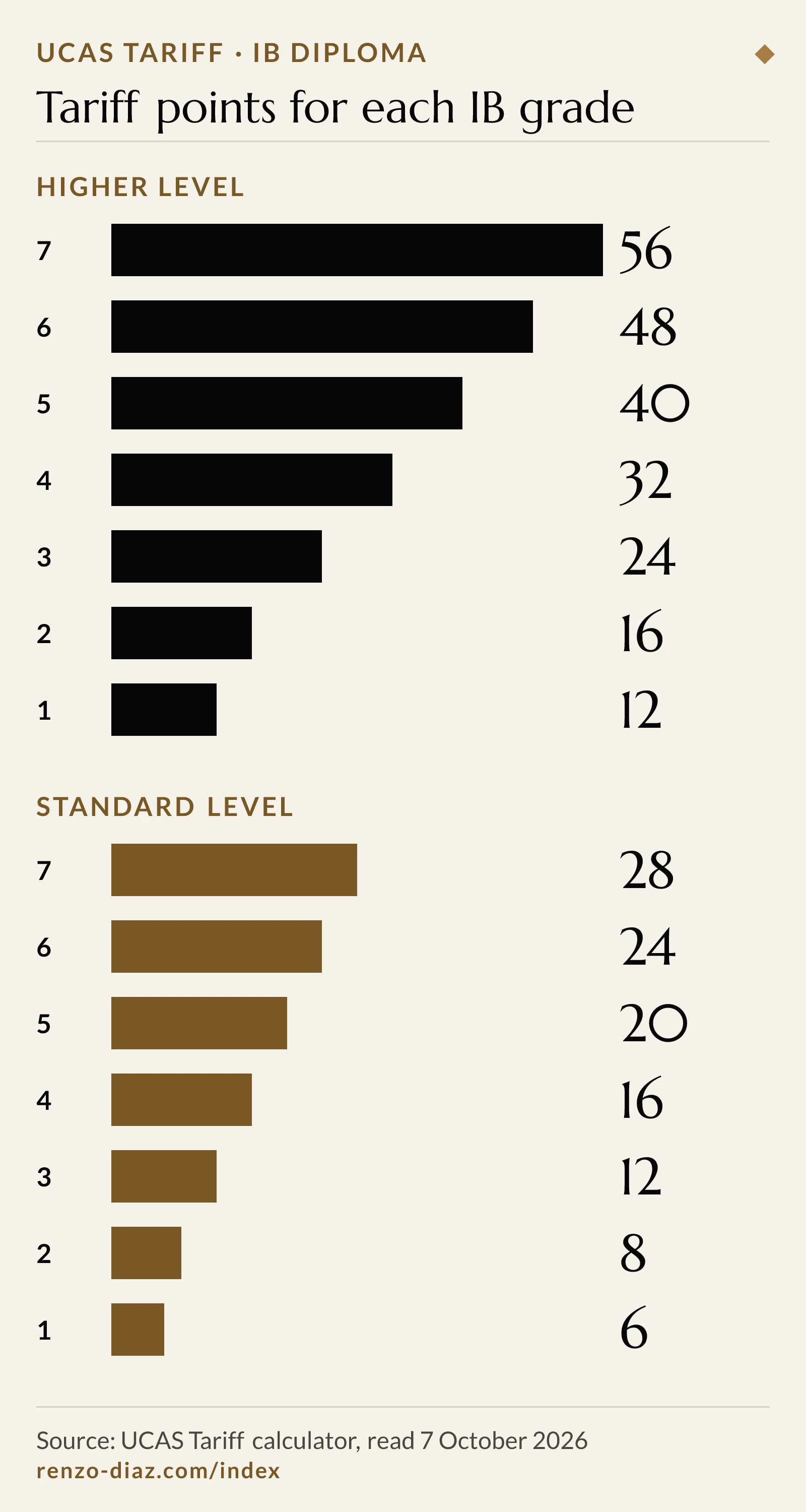
The UCAS Tariff gives no score to the IB Diploma as a whole. It scores the parts: each Higher Level subject (56 points for a 7), each Standard Level subject (28 for a 7), and the extended essay and Theory of Knowledge (12 each for an A), and the points are added up. A 45-point Diploma with 7s in all six subjects and an A in both comes to 276 Tariff points, so the two numbers are on different scales. Many universities do not use Tariff points at all, and selective courses state their IB offers as a total with Higher Level grades.
UCAS describes the Tariff as a way for universities and colleges to compare different qualifications fairly, especially less common ones, against familiar ones like A-levels. The IB Diploma is in the Tariff because it is regulated in the UK. It is unusual there: the Diploma as a whole has no Tariff value, the way a single A-level grade does.
This matters whenever a published requirement is written in Tariff points rather than in IB terms, which is not the norm for the UK's most selective courses but does happen. The points below are the ones UCAS's own calculator showed on 7 October 2026.
An IB total and a UCAS Tariff total are two different scales: comparing them directly gives the wrong answer.
Key takeaways
- No Tariff score for the Diploma: UCAS scores each HL subject, each SL subject, the extended essay and Theory of Knowledge.
- Higher Level counts double: at every grade, an HL subject earns twice the points of the same grade at SL; a 7 is 56 against 28.
- 45 IB points is 276 Tariff points: with 7s in all six subjects and an A in both the extended essay and Theory of Knowledge.
- Not every university uses it: UCAS states that many base their offers on qualifications and grades instead.
- On UCAS's course search: UCAS suggests IB students enter the Tariff points for their Higher Level subjects only.
How the Tariff scores the IB Diploma
UCAS's Tariff calculator lists the IB Diploma's parts under "International Baccalaureate (Composite parts)": the IBO Certificate in Higher Level, the IBO Certificate in Standard Level, and separate entries for the extended essay and Theory of Knowledge. There is no entry for the Diploma as a whole, and none for creativity, activity, service, which also adds nothing to the IB total.
| IB grade | Higher Level | Standard Level |
|---|---|---|
| 7 | 56 | 28 |
| 6 | 48 | 24 |
| 5 | 40 | 20 |
| 4 | 32 | 16 |
| 3 | 24 | 12 |
| 2 | 16 | 8 |
| 1 | 12 | 6 |
Source: UCAS Tariff calculator, entries "IBO Certificate in Higher Level" and "IBO Certificate in Standard Level", read 7 October 2026.
| Grade | Extended essay | Theory of Knowledge |
|---|---|---|
| A | 12 | 12 |
| B | 10 | 10 |
| C | 8 | 8 |
| D | 6 | 6 |
| E | 4 | 4 |
Source: UCAS Tariff calculator, entries "IBO Certificate in Extended Essay" and "IBO Certificate in Theory of Knowledge", read 7 October 2026. These score each component's own grade, A to E; they are separate from the up to 3 points the two together add to the IB total.
Check this
Use UCAS's calculator for your year
UCAS updates the calculator each year to reflect new or revised qualifications, and tables copied from older sources can differ, mostly at the lower grades. Before relying on a figure, look it up in UCAS's own calculator.
Your IB total and your Tariff total are different scales
The IB total runs to 45: each of six subjects is graded 7 to 1, and Theory of Knowledge and the extended essay together can add up to 3 points. The Tariff adds the parts on its own scale, with each Higher Level grade worth twice the same grade at Standard Level and the two core components scored separately. The same IB total can therefore give different Tariff totals, and a Tariff requirement cannot be read as an IB score. The IB points and UCAS calculator works out both from your own grades.
Worked example
45 IB points, 276 Tariff points
Three HL 7s, three SL 7s and an A in both the extended essay and Theory of Knowledge make a 45-point Diploma. On the Tariff: 3 × 56 + 3 × 28 + 12 + 12 = 276 points.
Worked example
The same subject points, two Tariff totals
A student with 7, 7, 7 at HL and 5, 5, 5 at SL and one with 5, 5, 5 at HL and 7, 7, 7 at SL both have 36 subject points. On the Tariff, before the core, the first has 3 × 56 + 3 × 20 = 228 points and the second 3 × 40 + 3 × 28 = 204.
Does the Tariff matter for IB applicants?
Sometimes, but not always in the way students assume. UCAS states that not all universities and colleges use Tariff points, and that many base their offers on qualifications and grades. Those that do use the Tariff set their own entry requirements: they do not have to accept a qualification because it is in the Tariff, they do not have to use UCAS's points, and they may count a qualification for fewer points if its content does not fit the course. UCAS calls its calculator an indicative guide.
For the IB specifically, UCAS tells advisers that universities can choose to accept Tariff points for the IB Diploma from both UK and international applicants. So the right conclusion is not that "competitive universities ignore the Tariff". It is narrower: use the course's own published requirement, and do not assume the Tariff is the measure being applied.
Using the Tariff with an IB Diploma
Read the course's own requirement
On the course page for your entry year, not a ranking site or a converter.
If it is in IB terms, use that
A total and Higher Level grades are the requirement; the Tariff adds nothing to it.
If it is only in Tariff points, ask
UCAS advises speaking to the university directly to find out whether the qualification is accepted, and how it is counted.
Searching on UCAS, enter HL points only
UCAS suggests IB students enter the Tariff points for their Higher Level subjects only, to refine the search.
“Some providers choose to show entry requirements as an overall score in the International Baccalaureate Diploma, rather than grades from individual certificates. Please check the entry requirements carefully.”
Why selective courses state their offers in IB terms
The clearest sign of how a course assesses IB applicants is whether it publishes its requirement in IB terms. Cambridge and LSE both do, as a total out of 45 with grades in the Higher Level subjects, and offers at that level often name a subject as well. A bare Tariff total cannot carry that detail: it does not say which subject was taken at Higher Level, or at which grade. Their published figures, and a way to record them for each course, are in the IB score checklist; what 30 UK programmes require in IB Mathematics is in AA or AI for university.
Terms used in this article
- UCAS Tariff
- UCAS's points scale for UK Level 3 qualifications, which lets universities compare different qualifications; each university decides whether and how to use it.
- Tariff points
- The points UCAS gives a grade in a qualification, added up across a student's qualifications.
- IBO Certificate in Higher Level
- UCAS's name, in the Tariff, for an IB subject taken at Higher Level; the Standard Level equivalent is the IBO Certificate in Standard Level.
- IB Diploma points
- The IB's own total, out of 45: grades 7 to 1 in six subjects, plus up to 3 points for Theory of Knowledge and the extended essay together.
- 776 at HL
- Grades of 7, 7 and 6 in the three Higher Level subjects, a common way for UK universities to set the HL part of an IB offer.
Questions about UCAS points and the IB Diploma
How many UCAS points is the IB Diploma worth?
The Diploma as a whole has no Tariff score; its parts do. Each HL and SL subject, the extended essay and Theory of Knowledge earn points, which are added up: 7s in all six subjects and an A in both core components make 276.
How many UCAS points is a 7 at Higher Level?
56 points; a 7 at Standard Level is 28. At every grade, Higher Level earns twice the points of Standard Level.
Do Theory of Knowledge and the extended essay count for UCAS points?
Yes: each has its own Tariff points, from 12 for an A to 4 for an E. They are scored separately from the up to 3 points they add to the IB total.
Do UK universities use UCAS points for IB students?
Some do; many do not. UCAS states that not all universities use Tariff points, and selective courses usually state their IB offers as a total with Higher Level grades.
What if a course gives its entry requirement only in UCAS points?
Ask the university whether it accepts the IB and how it counts it. That is UCAS's own advice, and a written answer is worth keeping.
How do I search UCAS courses with an IB Diploma?
UCAS suggests entering the Tariff points for your Higher Level subjects only. It notes that some courses show an overall IB score instead, so read each course's requirements as well.
Written by
Teaching IB since 2016. Seven years of IB reviews you can check on Google — and named results with the documents behind them.
Last reviewed October 7, 2026
Sources
Every Tariff value was read in UCAS's own Tariff calculator on 7 October 2026, and UCAS's statements come from its own pages, read the same day in a browser. The IB's scoring comes from the IB's assessment page. The worked examples are arithmetic on those values.
- UCAS — Calculate your UCAS Tariff points (Tariff calculator)
- UCAS — About the entry requirements filter
- UCAS — Qualifications advice for international advisers
- International Baccalaureate — Diploma Programme assessment
- University of Cambridge — Accepted qualifications (IB)
- LSE — Undergraduate entry requirements (IB)